
 Call For Appointment
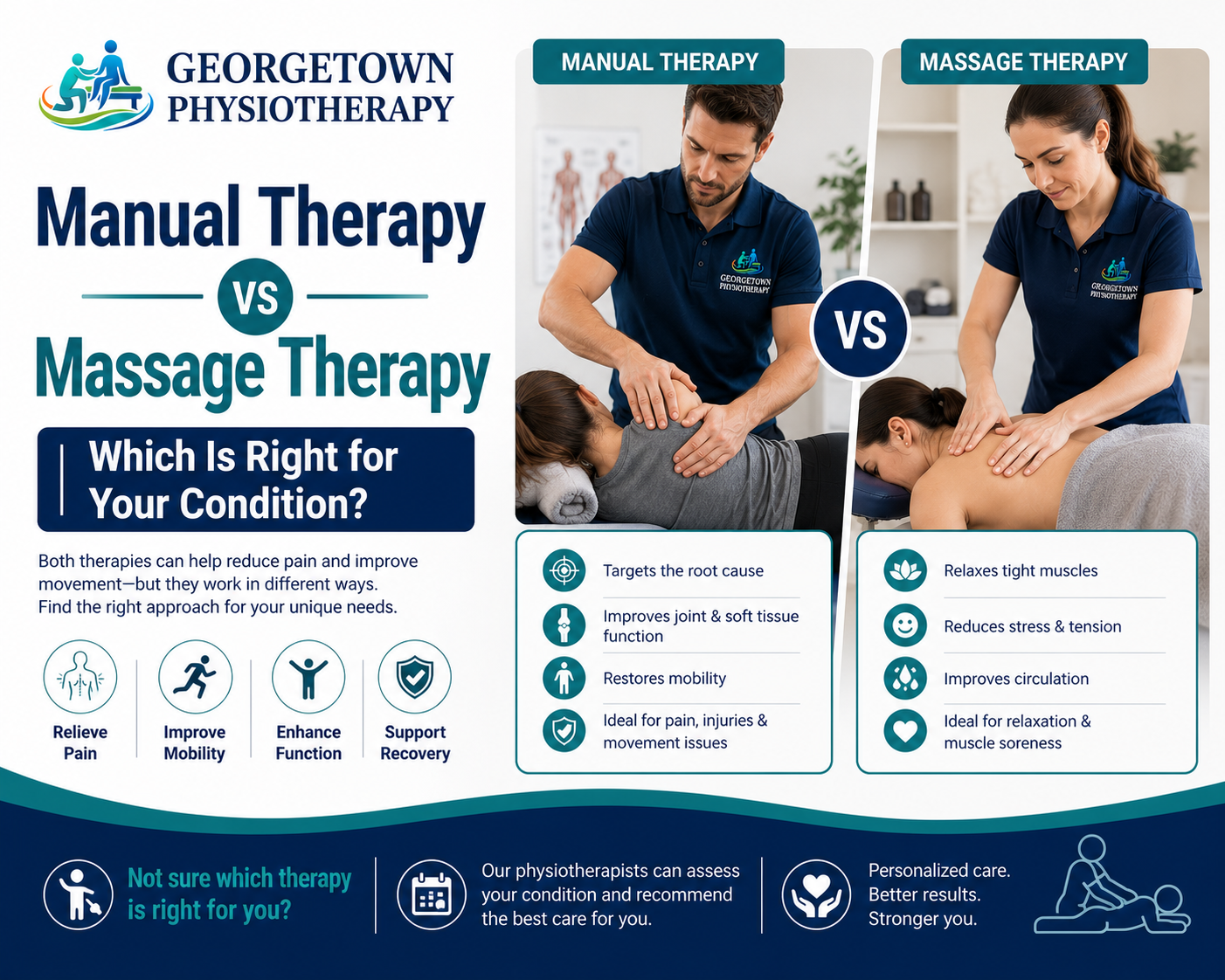
Manual Therapy vs Massage Therapy: Which Is Right for Your Condition?
When you’re experiencing pain, stiffness, or limited mobility, it’s natural to wonder which treatment will help you recover faster. Two commonly recommended treatments are Manual Therapy and Massage Therapy. While both involve hands-on techniques and aim to reduce pain and improve movement, they serve different purposes and are often used together as part of a comprehensive rehabilitation program.
At Georgetown Physiotherapy & Rehabilitation Centre, patients receive individualized treatment plans based on a detailed assessment. Depending on the cause of your pain and your recovery goals, your physiotherapist may recommend Manual Therapy, Massage Therapy, or a combination of both to help restore function and improve your quality of life.
Understanding the differences between these treatments can help you make informed decisions about your care.
What Is Manual Therapy?
Manual Therapy is a specialized treatment performed by a physiotherapist using hands-on techniques to improve joint mobility, reduce pain, restore movement, and improve overall function.
Unlike general massage, Manual Therapy focuses on the joints, muscles, nerves, and connective tissues that contribute to movement dysfunction.
Following a thorough assessment, the physiotherapist selects techniques specifically designed to address the underlying cause of your condition rather than simply relieving symptoms.
Common Manual Therapy Techniques
Depending on your condition, treatment may include:
- Joint mobilization
- Joint manipulation (when appropriate)
- Soft tissue mobilization
- Myofascial release
- Muscle energy techniques
- Trigger point release
- Neural mobilization
- Passive stretching
Each technique is chosen based on your symptoms, mobility restrictions, and rehabilitation goals.
What Conditions Can Manual Therapy Help Treat?
Manual Therapy is commonly recommended for:
- Lower back pain
- Neck pain
- Shoulder pain
- Hip pain
- Knee pain
- Sciatica
- Sports injuries
- Frozen shoulder
- Tendon injuries
- Joint stiffness
- Postural dysfunction
- Muscle tightness
- Repetitive strain injuries
It is often combined with therapeutic exercises to provide long-term improvements.
What Is Massage Therapy?
Massage Therapy is performed by a Registered Massage Therapist (RMT) and focuses primarily on soft tissues, including muscles, tendons, ligaments, and fascia.
Massage Therapy helps reduce muscle tension, improve circulation, relieve stress, and promote relaxation while supporting the body’s natural recovery process.
Although it is highly effective for muscle-related pain, Massage Therapy does not specifically correct joint mechanics or movement dysfunction in the way Manual Therapy does.
Common Massage Therapy Techniques
Massage Therapy may include:
- Swedish massage
- Deep tissue massage
- Trigger point therapy
- Myofascial release
- Sports massage
- Relaxation massage
- Lymphatic drainage
- Therapeutic stretching
The specific technique depends on your symptoms and treatment goals.
What Conditions Can Massage Therapy Help?
Massage Therapy is beneficial for many conditions, including:
- Muscle tension
- Stress-related pain
- Neck stiffness
- Back pain
- Sports recovery
- Muscle fatigue
- Headaches caused by muscle tension
- Postural discomfort
- Overuse injuries
- General muscle soreness
It can also help improve flexibility and support overall wellness.
Manual Therapy vs Massage Therapy: What’s the Difference?
Although both treatments involve hands-on care, their goals and techniques differ significantly.
| Manual Therapy | Massage Therapy |
|---|---|
| Performed by a physiotherapist | Performed by a Registered Massage Therapist |
| Focuses on joints, muscles, and movement | Focuses primarily on muscles and soft tissues |
| Corrects movement dysfunction | Relieves muscle tension |
| Improves joint mobility | Improves circulation |
| Addresses underlying mechanical problems | Promotes relaxation and muscle recovery |
| Often includes rehabilitation exercises | Often complements rehabilitation programs |
Both therapies have an important role in recovery, but they are used for different clinical purposes.
Which Treatment Is Better for Back Pain?
The answer depends on the underlying cause of your pain.
If back pain is caused by:
- Joint stiffness
- Poor spinal movement
- Disc-related dysfunction
- Movement limitations
Manual Therapy combined with Physiotherapy may provide greater long-term improvement.
If your pain is mainly due to:
- Tight muscles
- Muscle spasms
- Stress
- Muscle fatigue
Massage Therapy may help reduce discomfort and improve flexibility.
In many cases, combining both treatments provides the best results.
Which Treatment Is Better for Sports Injuries?
Athletes often benefit from both therapies.
Manual Therapy may help:
- Restore joint mobility
- Improve movement mechanics
- Reduce pain
- Improve performance
- Prevent future injuries
Massage Therapy may help:
- Reduce muscle soreness
- Improve circulation
- Speed recovery after training
- Reduce muscle tightness
- Improve flexibility
Using both treatments together often supports faster rehabilitation and a safer return to sports.
Can Manual Therapy and Massage Therapy Be Combined?
Absolutely.
Many rehabilitation programs include both treatments because they complement one another.
For example:
Massage Therapy may first reduce muscle tension, making it easier for the physiotherapist to restore normal joint movement using Manual Therapy.
Once pain decreases and mobility improves, patients typically begin strengthening and rehabilitation exercises to maintain long-term results.
This integrated approach often leads to better outcomes than relying on one treatment alone.
Other Treatments That May Be Recommended
Depending on your condition, your rehabilitation plan may also include additional therapies.
Physiotherapy
Physiotherapy forms the foundation of treatment by combining assessment, education, exercise therapy, Manual Therapy, and movement retraining.
Treatment goals include:
- Restoring mobility
- Improving strength
- Reducing pain
- Preventing future injuries
- Returning to daily activities safely
Laser Therapy
Laser Therapy uses therapeutic light energy to stimulate healing and reduce inflammation.
Benefits may include:
- Reduced pain
- Faster tissue healing
- Improved circulation
- Drug-free pain management
Laser Therapy is commonly used alongside Manual Therapy and Physiotherapy.
Chiropractic Care
For some patients, Chiropractic Care may help improve spinal alignment and joint function.
Following a detailed assessment, chiropractic treatment may be recommended to improve movement and support rehabilitation.
Recovery After Workplace and Motor Vehicle Injuries
Manual Therapy and Massage Therapy are frequently incorporated into rehabilitation following workplace or motor vehicle accidents.
WSIB Physiotherapy
Workplace injuries often involve repetitive strain, muscle injuries, joint restrictions, and back pain.
A personalized rehabilitation program may include Manual Therapy, Massage Therapy, strengthening exercises, and movement retraining to support a safe return to work.
MVA Injury Care
Following a motor vehicle accident, patients commonly experience whiplash, neck pain, lower back pain, and soft tissue injuries.
Combining Manual Therapy, Massage Therapy, Physiotherapy, and other evidence-based treatments can help restore movement and reduce pain during recovery.
How Do You Know Which Treatment Is Right for You?
The best treatment depends on:
- Your diagnosis
- The cause of your pain
- Joint mobility
- Muscle tightness
- Activity level
- Recovery goals
- Medical history
A comprehensive physiotherapy assessment helps determine the most effective combination of treatments for your individual needs.
Why Choose Georgetown Physiotherapy & Rehabilitation Centre?
At Georgetown Physiotherapy & Rehabilitation Centre, every patient receives a customized rehabilitation plan designed around their condition and personal goals.
The clinic offers:
- Physiotherapy
- Manual Therapy
- Massage Therapy
- Laser Therapy
- Chiropractic Care
- WSIB Physiotherapy
- MVA Injury Care
Patients from Georgetown, Acton, Glen Williams, Limehouse, Stewarttown, Norval, Halton Hills, and surrounding communities rely on the clinic for evidence-based treatment and compassionate care.
Conclusion
Manual Therapy and Massage Therapy are both valuable treatments, but they serve different purposes. Manual Therapy focuses on restoring joint mobility, correcting movement dysfunction, and improving physical function, while Massage Therapy primarily relieves muscle tension, improves circulation, and promotes relaxation.
At Georgetown Physiotherapy & Rehabilitation Centre, treatment is never one-size-fits-all. Following a thorough assessment, your rehabilitation team develops a personalized plan that may combine Manual Therapy, Massage Therapy, Physiotherapy, Laser Therapy, Chiropractic Care, WSIB Physiotherapy, and MVA Injury Care to help you recover safely and achieve lasting results. Whether you’re recovering from an injury, managing chronic pain, or looking to improve your mobility, the right combination of treatments can help you move with greater comfort and confidence.
Contact Georgetown Physiotherapy & Rehabilitation Centre
Georgetown Physiotherapy & Rehabilitation Centre
Address: 333 Mountainview Rd S, Unit #2, Georgetown, ON L7G 5S5, Canada
Phone: +1 905-702-6633
Email: info@georgetownphysiotherapy.ca
Website: https://georgetownphysiotherapy.ca/