





 Call For Appointment
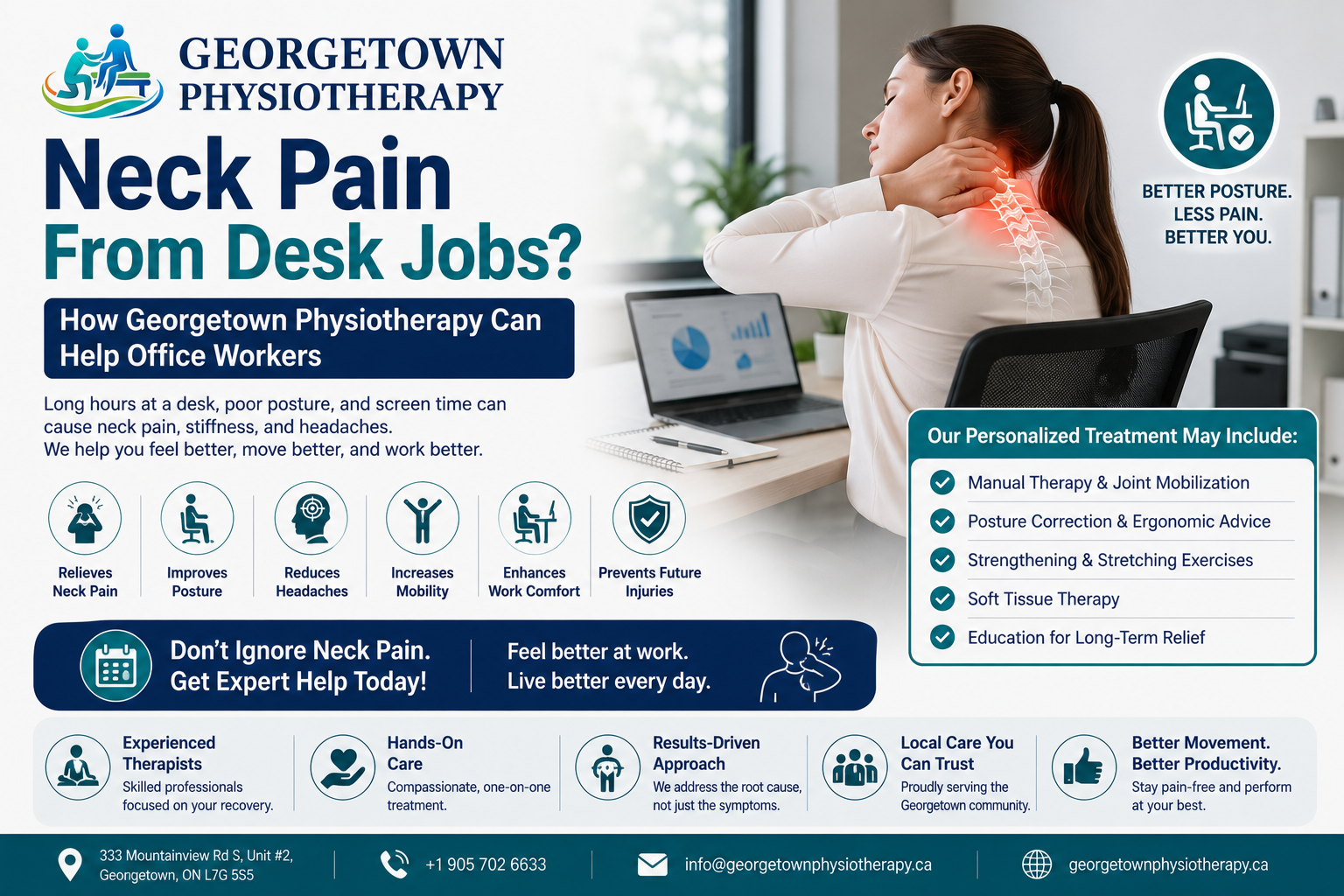
Neck Pain From Desk Jobs? How Georgetown Physiotherapy Can Help Office Workers
Neck pain has become a familiar problem for many office workers. Hours spent looking at a computer, working on a laptop, attending virtual meetings, using a smartphone, and remaining in the same position for long periods can leave the neck and shoulders feeling stiff, tired, or uncomfortable.
If you experience neck pain from a desk job, physiotherapy may help by assessing the factors contributing to your symptoms and creating an individualized plan to improve movement, strength, physical capacity, and everyday function. Treatment may include education, targeted exercises, movement strategies, hands-on techniques, and practical advice for managing the physical demands of desk-based work.
For office workers looking for neck pain physiotherapy in Georgetown, understanding why symptoms develop is an important first step. The goal is not simply to chase the idea of a single “perfect posture.” Instead, effective management often involves looking at how you sit, how often you move, your workstation, your physical capacity, your symptoms, and the demands of your workday.
Why Are Desk Jobs Commonly Associated With Neck Pain?
Desk work may not look physically demanding, but maintaining relatively static positions for long periods can be uncomfortable for many people.
During a typical workday, an office worker may spend hours:
- Looking at a computer monitor
- Typing on a keyboard
- Using a mouse
- Working from a laptop
- Looking down at a phone
- Attending virtual meetings
- Sitting for extended periods
- Repeating the same movements
The body generally benefits from movement and variation. Remaining in one position for a long time can contribute to discomfort, particularly when work demands, stress, limited breaks, workstation setup, sleep, and other individual factors are also involved.
Neck pain is rarely explained by one factor alone. This is why a physiotherapy assessment can be useful when symptoms persist or interfere with work and daily activities.
Is Poor Posture the Only Cause of Desk-Related Neck Pain?
No. Posture can influence comfort, but neck pain is often more complex than simply being caused by “bad posture.”
There is no single sitting position that every person must maintain throughout the entire workday. Even a position that initially feels comfortable can become uncomfortable if you remain there for too long.
A more practical approach is to think about movement variety and position tolerance.
Factors that may contribute to desk-related neck discomfort include:
- Prolonged sitting
- Limited movement during the day
- A workstation that does not suit the user
- Repeatedly looking down at a laptop or phone
- Reduced neck and upper-body mobility
- Muscle fatigue
- Stress and tension
- Changes in workload
- Previous injuries
- Reduced tolerance for sustained positions
Instead of trying to hold yourself in a rigid “perfect” posture for eight hours, it may be more useful to change positions regularly and build the physical capacity needed for your daily activities.
Common Symptoms Office Workers May Experience
Desk-related neck problems can feel different from person to person.
Common symptoms may include:
- Neck stiffness
- Aching around the neck
- Shoulder tension
- Discomfort between the shoulder blades
- Difficulty turning the head
- Symptoms that increase after prolonged computer use
- Headaches associated with neck symptoms in some cases
- Reduced tolerance for sitting
- Discomfort when looking down at a phone or laptop
Some people notice symptoms primarily during work. Others may continue to feel discomfort after the workday ends.
If symptoms are persistent, worsening, or affecting your ability to work, sleep, drive, exercise, or complete daily activities, an assessment may help determine appropriate next steps.
How Can Neck Pain Physiotherapy in Georgetown Help Office Workers?
Physiotherapy begins by looking at the individual rather than assuming that every office worker has the same problem.
A physiotherapist may assess your symptoms, movement, strength, functional limitations, work habits, and other relevant factors. Based on the findings, an individualized rehabilitation plan can be developed.
1. Understanding What May Be Contributing to Your Symptoms
The first step is identifying relevant factors.
Your physiotherapist may ask questions such as:
- When did the neck pain begin?
- What activities make it better or worse?
- How many hours do you spend at a desk?
- Do symptoms change throughout the day?
- Are you working from a laptop or desktop computer?
- How often do you take movement breaks?
- Does the pain affect sleep or daily activities?
- Have you experienced a previous neck injury?
This information helps create a more complete picture of your condition.
2. Assessing Neck and Upper-Body Movement
Neck discomfort may be associated with limitations or sensitivity during certain movements.
A physiotherapy assessment may examine:
- Neck range of motion
- Shoulder movement
- Upper-back mobility
- Strength
- Functional movement
- Tolerance for work-related positions
The assessment helps guide treatment rather than relying on a generic exercise program.
3. Developing an Individualized Exercise Program
Exercise is often an important component of physiotherapy for musculoskeletal problems.
Depending on your assessment and needs, your program may include exercises intended to support:
- Neck mobility
- Shoulder mobility
- Upper-back movement
- Strength
- Endurance
- Control of specific movements
- Tolerance for daily activities
The appropriate exercises and level of difficulty vary from person to person.
A program should be progressed according to your symptoms, goals, and response rather than following a one-size-fits-all routine found online.
4. Using Hands-On Treatment When Appropriate
Depending on the assessment and clinical judgment, physiotherapy may include hands-on techniques as part of a broader treatment plan.
These approaches may be used to help address symptoms or movement limitations, but long-term management often also involves active strategies such as exercise, education, and gradual improvements in physical capacity.
5. Helping You Manage the Demands of Desk Work
You may not be able to avoid computer work, but you may be able to change how you manage it.
Physiotherapy can help identify practical strategies for your workday, such as:
- Changing positions regularly
- Breaking up long periods of sitting
- Adjusting your workstation where appropriate
- Introducing manageable movement breaks
- Building tolerance for work-related activities
- Using exercises that fit into your routine
The goal is to create realistic strategies that can be maintained during an actual workday.
What Does a Physiotherapy Assessment for Neck Pain Involve?
If you visit a physiotherapist for desk-related neck pain, the first appointment typically focuses on understanding your symptoms and how they affect your life.
The physiotherapist may discuss:
- When your symptoms started
- Where you feel discomfort
- What movements or positions affect the symptoms
- Your work setup
- Your daily activities
- Previous injuries
- Relevant medical history
- Your goals for treatment
A physical assessment may then examine movement, strength, mobility, and function.
The findings can help guide a treatment plan based on your individual needs.
What Can Office Workers Do During the Workday?
Small changes can make desk work more manageable. The most useful strategy is often not one dramatic adjustment but a combination of practical habits.
Change Positions Regularly
The body may become uncomfortable when kept in the same position for too long.
Try varying your position during the day rather than attempting to maintain one rigid sitting posture for hours.
Take Short Movement Breaks
Brief periods of movement can help break up prolonged sitting.
Depending on your work environment, you might:
- Stand up between tasks
- Walk briefly
- Change your sitting position
- Perform comfortable movements recommended for you
- Take phone calls while standing when practical
The best movement strategy is one you can realistically maintain.
Position Your Screen Appropriately
A monitor that is consistently too low, too high, or far to one side may make certain positions harder to tolerate.
If you work primarily from a laptop, an external keyboard and mouse may allow greater flexibility in positioning the screen and input devices.
Keep Frequently Used Items Accessible
Repeatedly reaching or twisting for commonly used items may contribute to unnecessary strain.
Arrange your workspace so that your keyboard, mouse, phone, and other frequently used items are reasonably accessible.
Avoid Depending on Ergonomics Alone
A new chair or desk may improve comfort, but equipment alone does not address every possible contributor to neck pain.
Workstation setup is one part of a broader strategy that may also include movement, exercise, recovery, sleep, stress management, and rehabilitation when needed.
Is a Standing Desk the Solution to Neck Pain?
A standing desk can be useful for some people because it provides another working position. However, standing all day is not automatically better than sitting all day.
The key advantage may be the ability to change positions.
A sit-stand workstation can allow some workers to alternate between sitting and standing. However, the setup should still be comfortable, and standing time should be introduced according to individual tolerance.
Simply replacing eight hours of sitting with eight hours of standing may create a different set of discomforts.
The broader principle is simple: variation is often more practical than remaining in one position all day.
How Long Does Physiotherapy for Desk-Related Neck Pain Take?
There is no universal treatment timeline.
The length of rehabilitation may depend on factors such as:
- How long you have had symptoms
- The severity and irritability of the condition
- Your movement and strength
- Your daily work demands
- Previous injuries
- Your overall health
- Your response to treatment
- Your ability to follow an appropriate home program
Some people may notice changes relatively quickly, while others with persistent or complex symptoms may require a longer rehabilitation process.
A physiotherapist can reassess progress and modify the treatment plan as needed.
When Should You Seek Professional Help for Neck Pain?
Consider seeking an assessment when neck pain:
- Persists despite reasonable self-management
- Continues to return
- Is getting worse
- Limits your ability to turn your head
- Interferes with work
- Affects sleep or daily activities
- Makes driving or exercise difficult
Certain symptoms require more urgent medical attention. Seek prompt medical care after significant trauma or if neck pain occurs with serious or rapidly worsening neurological symptoms, severe unexplained symptoms, or other concerning signs.
When you are uncertain about the severity of your symptoms, consult an appropriate healthcare professional.
Common Mistakes Office Workers Make With Neck Pain
Waiting Until the Pain Becomes Difficult to Manage
Some people ignore recurring symptoms for weeks or months because the discomfort initially seems minor.
Persistent symptoms may become more disruptive over time. An earlier assessment can help identify relevant factors and establish a management plan.
Searching for a “Perfect” Posture
Trying to hold one rigid position all day can create unnecessary tension.
Instead of obsessing over perfect posture, focus on comfortable positioning, movement variety, and your ability to tolerate daily activities.
Stretching Without Understanding the Problem
Stretching may feel helpful for some people, but it is not automatically the solution to every type of neck pain.
The appropriate exercises depend on the individual.
Relying Only on Passive Treatment
Short-term symptom relief can be valuable, but a broader rehabilitation plan may also need to address movement, strength, endurance, work habits, and functional capacity.
Ignoring Workstation Habits
Exercise outside work may help, but spending long periods in uncomfortable or unchanging positions can still be relevant.
Your treatment strategy should consider what happens during the rest of your day.
Physiotherapy vs Massage Therapy for Desk-Related Neck Pain
Both physiotherapy and massage therapy may play a role in managing musculoskeletal concerns, but they are different services.
Physiotherapy commonly involves assessment, movement-based rehabilitation, exercise, education, and strategies for improving function.
Massage therapy commonly focuses on soft tissues and may help some people manage muscle tension and discomfort.
The most appropriate option depends on your symptoms, goals, preferences, and assessment findings. In some situations, different services may complement one another as part of a coordinated plan.
Can Physiotherapy Prevent Neck Pain From Returning?
No treatment can guarantee that neck pain will never return.
However, physiotherapy may help you better understand factors associated with your symptoms and develop strategies for managing future flare-ups.
A long-term approach may include:
- Maintaining regular physical activity
- Continuing appropriate exercises
- Building strength and endurance
- Changing positions during the workday
- Managing workload and recovery
- Adjusting the workstation when needed
- Responding appropriately when symptoms begin to increase
The goal is not necessarily to create a life in which the neck is never challenged. It is to improve your capacity to handle the demands of work and daily activity.
Frequently Asked Questions About Neck Pain From Desk Jobs
Can sitting at a desk all day cause neck pain?
Prolonged desk work may contribute to neck discomfort for some people, particularly when combined with limited movement, repetitive tasks, workstation factors, stress, or other individual contributors. Neck pain is often multifactorial rather than caused by one position alone.
Can physiotherapy help neck pain from computer work?
Physiotherapy may help by assessing factors related to your symptoms and creating an individualized plan that may include exercise, education, movement strategies, and other appropriate treatments.
How often should office workers take movement breaks?
There is no single schedule that is ideal for everyone. The practical goal is to avoid remaining in one position for excessively long periods. Short, regular changes in position or movement may be easier to maintain than relying on occasional long breaks.
Is bad posture permanently damaging my neck?
Posture alone does not provide a complete explanation for most neck pain. Comfort, movement variety, physical capacity, work demands, stress, sleep, previous injuries, and other factors may all be relevant.
Should I use heat or ice for desk-related neck pain?
The appropriate approach depends on the individual and the nature of the symptoms. Some people find heat or cold temporarily comfortable, but these strategies do not replace an assessment when symptoms are persistent, worsening, or concerning.
Do I need a referral to see a physiotherapist?
Referral and insurance requirements can vary. Contact the clinic and your insurance provider, where applicable, to confirm the requirements for your situation.
Looking for Neck Pain Physiotherapy in Georgetown?
Desk work is a normal part of life for many people, but recurring neck pain does not have to be ignored.
If your symptoms are affecting your concentration, workday, sleep, driving, exercise, or everyday activities, a physiotherapy assessment can help identify relevant factors and establish a personalized plan.
At Georgetown Physiotherapy & Rehabilitation Centre, we provide physiotherapy and rehabilitation services for people dealing with neck pain, musculoskeletal concerns, injuries, and movement limitations.
Georgetown Physiotherapy & Rehabilitation Centre
333 Mountainview Rd S, Unit #2
Georgetown, ON L7G 5S5, Canada
Phone: +1 905-702-6633
Email: info@georgetownphysiotherapy.ca
Contact the clinic to learn more about appointment availability and physiotherapy services.
Take the Next Step Toward a More Comfortable Workday
Neck pain from desk work can develop for many reasons, and the solution is not always as simple as buying a new chair or forcing yourself to sit perfectly straight.
A more complete approach considers your symptoms, movement, strength, work environment, daily habits, and individual goals.
If you are searching for neck pain physiotherapy in Georgetown, contact Georgetown Physiotherapy & Rehabilitation Centre to discuss your concerns and request an appointment. An individualized assessment can help you better understand your symptoms and determine appropriate next steps for your recovery and daily function.