




 Call For Appointment

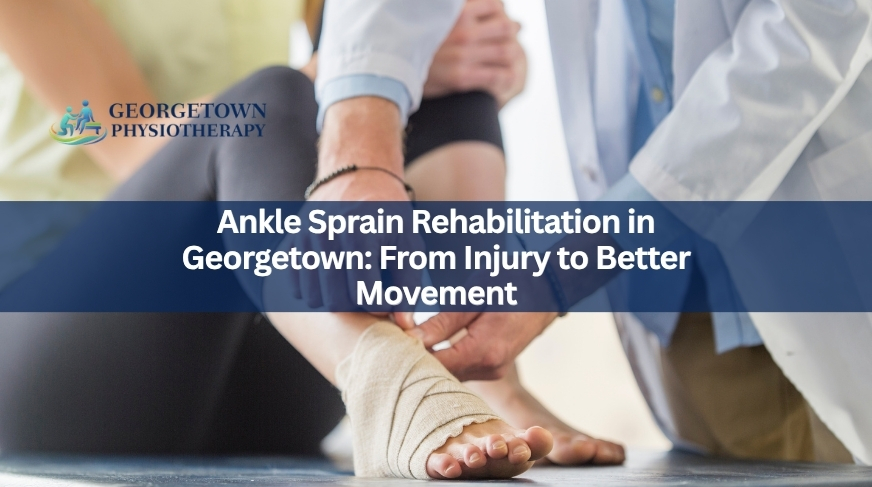
Ankle Sprain Rehabilitation in Georgetown: From Injury to Better Movement
An ankle sprain can happen in seconds.
A misstep on a curb, landing awkwardly after a jump, changing direction during a sport or simply rolling your ankle can lead to pain, swelling and difficulty putting weight through the foot.
While some ankle sprains improve relatively quickly, others can leave behind stiffness, weakness or a feeling that the ankle is unstable.
That is why ankle sprain physiotherapy in Georgetown can be useful for people who want to restore movement, strength, balance and confidence after an injury.
An ankle sprain rehabilitation program is not simply about waiting for swelling and pain to disappear. Depending on the severity of the injury, rehabilitation may involve gradually restoring range of motion, strength, balance, coordination and tolerance for everyday or sporting activities.
The appropriate approach depends on the injury and the individual.
The American Physical Therapy Association’s clinical practice guideline for lateral ankle ligament sprains addresses assessment and management of acute ankle sprains and ankle instability in adolescents and adults.
Quick Answer: How Can Physiotherapy Help an Ankle Sprain?
Physiotherapy may help after an ankle sprain by addressing pain, swelling, mobility, strength, balance, coordination and functional movement.
Early rehabilitation may focus on protecting the injured area while gradually restoring comfortable movement. As recovery progresses, treatment may involve strengthening and balance exercises, functional activities and a gradual return to work, exercise or sport.
The exact rehabilitation plan depends on the severity of the injury, symptoms, physical demands and recovery goals.
What Is an Ankle Sprain?
An ankle sprain occurs when one or more ligaments around the ankle are injured.
Ligaments are strong bands of connective tissue that help stabilize joints.
Ankle sprains commonly involve the ligaments on the outside of the ankle, particularly after the foot rolls inward.
A sprain can range from a relatively mild injury to a more significant ligament injury.
Symptoms may include:
- Pain
- Swelling
- Bruising
- Tenderness
- Reduced ankle movement
- Difficulty walking
- Weakness
- A feeling of instability
The severity of symptoms does not always tell you exactly how serious the injury is.
An assessment can help determine the appropriate next step.
How Do Ankle Sprains Happen?
Ankle sprains can occur during many different activities.
Common situations include:
- Landing awkwardly after a jump
- Running on uneven ground
- Quickly changing direction
- Stepping into a hole or depression
- Rolling the ankle while walking
- Participating in basketball, soccer or other sports
- Falling or losing balance
You do not have to be an athlete to sprain your ankle.
A simple misstep during everyday activity can be enough.
What Are the Common Symptoms?
An ankle sprain can cause a combination of symptoms.
Pain
Pain may occur around the injured ligament or surrounding tissues.
It may become more noticeable when you put weight through the foot or move the ankle in certain directions.
Swelling
Swelling can occur around the ankle following an injury.
The amount of swelling can vary considerably.
Bruising
Some people develop bruising around the ankle or foot.
Stiffness
As pain and swelling settle, you may still notice difficulty moving the ankle normally.
Difficulty Walking
Weight-bearing may initially be uncomfortable.
Some people change the way they walk to avoid putting pressure on the injured side.
Instability
After an ankle sprain, some people feel that the ankle is weak or may “give way.”
Persistent instability deserves attention because simply returning to normal activity without addressing strength and movement control may not be ideal.
Do You Need an X-Ray After an Ankle Sprain?
Not every ankle injury requires an X-ray.
Healthcare professionals may use clinical decision rules, including the Ottawa Ankle Rules, to help determine whether radiography may be appropriate after an acute foot or ankle injury.
The Ottawa Ankle Rules consider specific areas of bone tenderness and the person’s ability to bear weight. A positive test can indicate that radiography is appropriate.
This is one reason it is important not to assume that every ankle injury is “just a sprain.”
If you have significant pain, difficulty bearing weight, marked tenderness over specific bones, or other concerning symptoms after an injury, appropriate medical assessment may be necessary.
What Happens During an Ankle Physiotherapy Assessment?
A physiotherapy assessment can help determine your current limitations and guide rehabilitation.
Your physiotherapist may ask:
- How did the injury happen?
- When did it happen?
- Did you hear or feel a pop?
- How much swelling developed?
- Can you put weight through the foot?
- Have you injured this ankle before?
- What activities do you want to return to?
- Are you experiencing instability?
The physical assessment may consider:
- Ankle range of motion
- Strength
- Balance
- Walking pattern
- Swelling
- Tenderness
- Functional movement
- Stability
- Lower-limb movement
The assessment findings can help determine whether physiotherapy is appropriate and what type of rehabilitation may be useful.
The Stages of Ankle Sprain Rehabilitation
Recovery does not necessarily follow a perfectly linear path, but rehabilitation can generally progress from protecting the injury toward restoring normal function.
Stage 1: Protect and Manage Symptoms
Immediately after an ankle injury, the priority may be reducing excessive stress on the injured tissues and managing symptoms.
Depending on the injury, this may involve modifying activities and using appropriate support.
Your physiotherapist or healthcare provider can advise you based on the injury.
The objective is not necessarily complete inactivity.
Rather, it is to find an appropriate level of movement and loading while the ankle begins to recover.
Stage 2: Restore Comfortable Movement
Once symptoms allow, rehabilitation may focus on restoring ankle movement.
Stiffness can affect walking mechanics and make it harder to perform everyday activities.
Exercises may be selected to gradually improve relevant ankle movement without unnecessarily aggravating symptoms.
Stage 3: Rebuild Strength
Strength is an important part of ankle rehabilitation.
Exercises may target the muscles surrounding the ankle and lower leg.
Depending on your needs, rehabilitation could progress from simple movements toward more demanding exercises involving:
- Calf muscles
- Ankle stabilizers
- Foot muscles
- Lower-leg muscles
- Hip and lower-limb muscles
The goal is to gradually restore the strength required for your daily activities or sport.
Stage 4: Improve Balance and Proprioception
An ankle sprain can affect balance and the body’s awareness of where the foot is positioned.
Balance exercises can therefore become an important part of rehabilitation.
Depending on the stage of recovery, exercises may progress from:
- Standing on two feet
- Single-leg standing
- Reaching while balancing
- Controlled stepping
- Dynamic balance activities
The APTA identifies measures such as the Star Excursion Balance Test as relevant functional assessments for people with ankle sprains and ankle stability problems.
Stage 5: Return to Functional Activity
The final stage should reflect what you actually want to return to.
For someone recovering from an ankle sprain, that could mean:
- Walking comfortably
- Returning to work
- Going up and down stairs
- Hiking
- Running
- Playing soccer
- Playing basketball
- Returning to the gym
The rehabilitation demands for a recreational walker will be different from those of a competitive athlete.
Why Is Balance Important After an Ankle Sprain?
An ankle can feel much better before it has fully regained its ability to respond to sudden changes in movement.
This matters during activities such as:
- Running
- Jumping
- Cutting
- Changing direction
- Landing
- Walking on uneven surfaces
Balance and movement-control exercises can help challenge these abilities progressively.
The goal is not simply to stand on one leg.
It is to develop the control required for the activities you want to perform.
Can an Ankle Sprain Happen Again?
Yes.
A previous ankle sprain can be associated with ongoing instability or future injury risk in some individuals.
This makes rehabilitation particularly important for people who want to return to sports or physically demanding activities.
Returning to sport solely because the pain has decreased may not mean that strength, balance and movement control have fully recovered.
A more structured return-to-activity process can help identify remaining limitations.
How Long Does an Ankle Sprain Take to Heal?
There is no single recovery timeline for every ankle sprain.
Recovery depends on factors such as:
- Severity of the ligament injury
- Swelling
- Pain
- Previous ankle injuries
- Strength
- Balance
- Activity demands
- Rehabilitation progress
A mild sprain may improve relatively quickly, while a more significant injury may require a longer rehabilitation period.
Instead of promising a fixed number of days or weeks, rehabilitation should be based on how your ankle responds and whether you are regaining the abilities required for your normal activities.
Can You Walk With an Ankle Sprain?
It depends on the severity of the injury.
Some people can walk with a mild sprain, while others may have substantial difficulty putting weight through the affected foot.
If walking is extremely painful or you cannot bear weight after an injury, appropriate assessment is important.
A physiotherapist or other healthcare professional can help determine what level of weight-bearing and activity is appropriate.
When Should You Seek Medical Assessment?
An ankle injury should not automatically be assumed to be a simple sprain.
Seek appropriate medical assessment if:
- You cannot bear weight
- Pain is severe
- There is significant swelling
- The ankle appears deformed
- You have marked tenderness over the bones
- You heard a significant crack during the injury
- Your symptoms are worsening
- You have numbness or unusual weakness
- You are concerned that you may have fractured the ankle
Clinical decision tools such as the Ottawa Ankle Rules can assist healthcare professionals in deciding whether imaging may be appropriate.
What Exercises Are Used for Ankle Sprain Rehabilitation?
Exercise selection should be individualized.
Depending on the stage of recovery, rehabilitation may include:
Range-of-Motion Exercises
These can help restore comfortable ankle movement.
Calf Strengthening
Exercises may progressively challenge the calf and ankle muscles.
Resistance Exercises
Resistance bands or other forms of resistance may be used to strengthen ankle movement.
Balance Exercises
Single-leg and dynamic balance exercises can challenge stability and coordination.
Functional Exercises
Later rehabilitation may include movements that resemble work, sport or everyday activities.
Running and Jumping Progressions
For active individuals, higher-level exercises may eventually be introduced when appropriate.
The key is progression.
An exercise that is appropriate during one stage of recovery may be too demanding at another stage.
Should You Use an Ankle Brace?
In some cases, external support may be recommended during the recovery period.
The appropriate type and duration depend on the injury and individual circumstances.
A brace should not necessarily replace rehabilitation.
The longer-term objective is to restore the ankle’s ability to tolerate movement and load.
Your physiotherapist can help determine whether support is appropriate for your activities.
Returning to Sport After an Ankle Sprain
Returning to sport should involve more than simply waiting until the ankle stops hurting.
Depending on the sport, you may need to regain:
- Full or functional range of motion
- Strength
- Balance
- Coordination
- Agility
- Jumping and landing control
- Running tolerance
- Confidence
A soccer player, for example, may need to demonstrate the ability to accelerate, decelerate and change direction.
A runner may need to gradually rebuild running volume.
A recreational gym user may need to tolerate exercises such as lunges, squats or step-ups.
Your return-to-activity plan should reflect your specific goals.
How Can Physiotherapy Help Prevent Future Ankle Problems?
A rehabilitation program can identify areas that may need additional attention after an ankle sprain.
This may include:
- Weakness
- Poor balance
- Movement-control deficits
- Reduced confidence
- Difficulty tolerating higher loads
Addressing these factors can help you build the capacity needed for your normal activities.
However, no rehabilitation program can guarantee that another ankle injury will never occur.
The goal is to improve function and prepare the ankle for the demands placed on it.
Frequently Asked Questions
Can physiotherapy help an ankle sprain?
Yes. Physiotherapy may help restore ankle movement, strength, balance, stability and functional capacity after an ankle sprain.
How soon should I start physiotherapy after an ankle sprain?
The appropriate timing depends on the severity of the injury. Early assessment can help determine what level of movement and loading is appropriate.
Do all ankle sprains need an X-ray?
No. Clinical decision rules such as the Ottawa Ankle Rules can help healthcare professionals determine when radiography may be appropriate.
Can I walk on a sprained ankle?
Some people can walk after a mild sprain, while others cannot comfortably bear weight. Severe difficulty bearing weight should be assessed appropriately.
How long does ankle sprain rehabilitation take?
Recovery varies depending on injury severity, symptoms, previous injuries, activity demands and rehabilitation progress.
Why does my ankle still feel weak after a sprain?
Pain, reduced activity and changes in balance or movement control can contribute to weakness or instability. Rehabilitation can address these factors.
Can I return to sports once the pain is gone?
Not necessarily. Depending on the sport, you may also need to regain strength, balance, coordination, agility and tolerance for sport-specific movements.
Can an ankle sprain cause long-term instability?
Some people develop persistent ankle instability after repeated or inadequately rehabilitated sprains. Assessment and appropriate rehabilitation can help identify ongoing deficits.
Where can I get ankle sprain physiotherapy in Georgetown?
Georgetown Physiotherapy & Rehabilitation Centre provides physiotherapy and rehabilitation services in Georgetown, Ontario. An assessment can help determine an appropriate rehabilitation plan following an ankle injury.
Better Movement Starts With the Right Rehabilitation Plan
An ankle sprain may initially seem like an injury that simply needs time.
But getting back to normal movement involves more than waiting for pain and swelling to disappear.
Restoring mobility, rebuilding strength, improving balance and gradually increasing activity can all be important parts of recovery.
For people returning to work, exercise or sport, rehabilitation should reflect the demands they need to handle.
At Georgetown Physiotherapy & Rehabilitation Centre, an individualized assessment can help identify your current limitations and guide a rehabilitation program based on your injury, activities and goals.
Georgetown Physiotherapy & Rehabilitation Centre
333 Mountainview Rd S, Unit #2Georgetown, ON L7G 5S5
Phone: +1 905 702 6633
Email: info@georgetownphysiotherapy.ca
If an ankle sprain is affecting your walking, work, exercise or sport, contact the clinic to discuss an assessment and appropriate next steps.