




 Call For Appointment

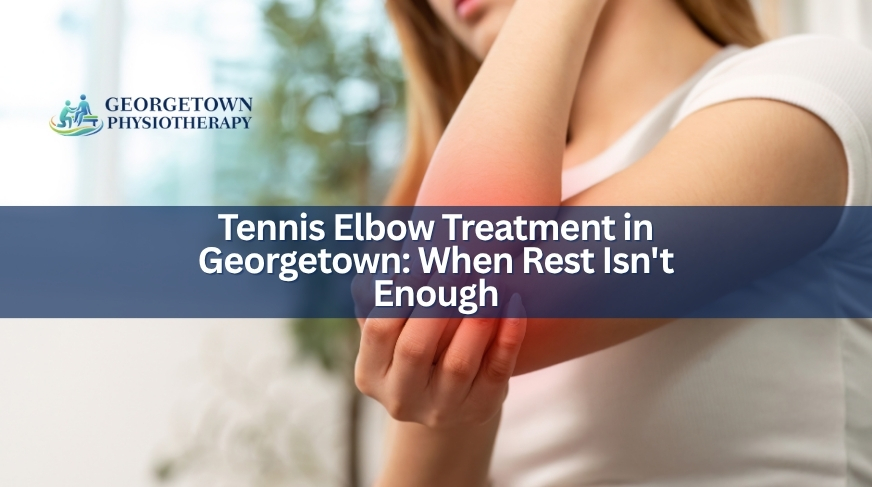
Tennis Elbow Treatment in Georgetown: When Rest Isn’t Enough
Elbow pain can make everyday tasks surprisingly difficult. Turning a doorknob, lifting a mug, carrying grocery bags, gripping tools or working at a computer may become uncomfortable when the outer part of your elbow is irritated.
One possible cause is tennis elbow, a condition commonly associated with pain around the outer elbow and the tendons that help extend the wrist.
For people searching for tennis elbow physiotherapy in Georgetown, rest may provide some relief, but prolonged avoidance of activity does not always restore the strength and capacity needed for everyday tasks. Depending on the condition, a structured rehabilitation program may help address pain, improve forearm strength and support a gradual return to normal activities.
At Georgetown Physiotherapy & Rehabilitation Centre, an individualized assessment can help determine what may be contributing to your elbow pain and whether physiotherapy is appropriate.
Can Physiotherapy Help Tennis Elbow?
Yes. Physiotherapy may help people with tennis elbow by addressing pain, forearm strength, tendon loading and the activities that aggravate symptoms.
Treatment may include progressive strengthening exercises, education, activity modification and selected manual therapy techniques. The appropriate plan depends on the severity and duration of symptoms, your work or sporting demands, and your response to treatment.
Research suggests that physiotherapy and prescribed exercises may provide some short-term improvement in pain and disability, although the certainty of evidence is limited and benefits are not guaranteed to persist. Cochrane’s review of manual therapy and exercise for tennis elbow discusses these limitations.
What Is Tennis Elbow?
Tennis elbow is commonly known medically as lateral elbow tendinopathy or lateral epicondylalgia. It involves pain around the outer side of the elbow, often associated with the tendons of muscles that extend the wrist and fingers.
Despite its name, you do not need to play tennis to develop it.
The condition can affect people who perform repetitive or physically demanding tasks at work, at home, in the gym or during sports.
Symptoms may develop gradually rather than following one obvious injury. Repeated gripping, lifting, twisting or wrist movements may aggravate the area.
The condition can affect your ability to use the arm comfortably, even when the task seems relatively light.
What Are the Common Symptoms?
Tennis elbow typically causes pain around the bony prominence on the outside of the elbow. The discomfort may spread into the forearm.
Common symptoms include:
- Pain when gripping objects
- Discomfort when lifting a kettle or mug
- Pain when turning a handle or tool
- Difficulty carrying shopping bags
- Pain during wrist extension
- Reduced confidence when lifting
- Discomfort during racquet sports or weight training
Some people describe the arm as weak, particularly when gripping or lifting. This may partly reflect pain limiting how much force they can comfortably produce.
If you experience numbness, tingling, significant loss of movement or symptoms following major trauma, another condition may need to be considered.
Why Does Tennis Elbow Develop?
Tennis elbow is often associated with repeated loading of the forearm tendons.
It can develop when the demands placed on the arm exceed its current capacity, particularly when activity increases without enough time for adaptation and recovery.
Possible contributing factors include:
Repetitive Work
Jobs involving frequent gripping, lifting, twisting or tool use may place repeated demands on the forearm.
Computer and Desk Tasks
Prolonged computer work may contribute to symptoms in some people, particularly when combined with sustained gripping, repetitive wrist movement or limited variation in tasks. However, computer use is not automatically the cause of every case of elbow pain.
Sports and Exercise
Tennis, badminton, weight training and other activities involving repeated gripping or wrist movement may aggravate the tendons.
Sudden Changes in Activity
A rapid increase in training volume, lifting demands or manual work may exceed the arm’s current capacity.
Reduced Strength or Load Tolerance
If the forearm has not adapted to a particular workload, repeated tasks may become difficult to tolerate.
These factors do not prove the cause in an individual case. An assessment can help determine which activities and findings are most relevant.
Why Isn’t Rest Always Enough?
Reducing activities that aggravate elbow pain can be helpful, particularly when symptoms are severe.
However, rest alone does not necessarily rebuild the strength and load tolerance needed for work, sport or everyday tasks.
Consider someone who stops lifting weights because gripping causes elbow pain. The symptoms may settle while activity is reduced, but the elbow may still struggle when the person returns to the same workload.
A more structured approach can combine temporary activity modification with progressive strengthening and a gradual return to demanding tasks.
The goal is not to push through significant pain. It is to find an appropriate level of activity and increase it as the arm becomes better able to tolerate the load.
How Can Physiotherapy Help Tennis Elbow?
Physiotherapy aims to address the individual’s symptoms, functional limitations and activity demands. The treatment plan should be based on an assessment rather than a standard routine for everyone.
1. Forearm Strengthening
Progressive strengthening may help improve the capacity of the muscles and tendons involved in wrist and grip function.
Depending on your assessment, exercises may target wrist extension, wrist flexion, forearm rotation and grip strength.
Exercises can begin at a manageable level and progress according to symptoms and tolerance.
2. Gradual Tendon Loading
Tendons respond to mechanical loading, but the amount of load matters.
Your physiotherapist may help you identify a suitable starting point and gradually progress resistance, repetitions or task difficulty.
The objective is to improve your ability to perform daily tasks without repeatedly provoking a significant flare-up.
3. Activity Modification
You may not need to stop all work, exercise or household activities.
Instead, your physiotherapist may help you adjust the way certain tasks are performed.
Possible changes include:
- Reducing repeated forceful gripping
- Breaking long tasks into shorter periods
- Alternating demanding activities with lighter tasks
- Adjusting lifting technique
- Temporarily modifying gym exercises
- Reviewing sports technique or equipment where relevant
These changes can reduce unnecessary aggravation while you work on rebuilding capacity.
4. Manual Therapy
Selected manual therapy techniques may be considered alongside exercise when appropriate.
However, manual therapy should not be presented as a guaranteed solution or a replacement for active rehabilitation. Evidence from Cochrane suggests that manual therapy and exercise may provide modest short-term improvements for some people, with uncertainty about the size and durability of the effects.
5. Education and Self-Management
Understanding how to manage your workload is an important part of rehabilitation.
Your physiotherapist may explain how to monitor symptoms, adjust exercises and progress activity without repeatedly overloading the elbow.
This can help you make more informed decisions between appointments.
What Happens During a Tennis Elbow Assessment?
A physiotherapy assessment may include questions about:
- When the pain began
- Whether symptoms developed gradually or after an injury
- Which activities aggravate the elbow
- Your occupation and daily tasks
- Sports or exercise participation
- Previous elbow problems
- Grip and lifting difficulties
- Your goals for recovery
The physical examination may assess tenderness, wrist and elbow movement, grip function, strength and symptoms during selected movements.
The purpose is to determine whether your symptoms are consistent with tennis elbow and whether another problem needs further investigation.
Imaging is not routinely necessary for every typical presentation, but a healthcare professional may recommend further investigation if the diagnosis is uncertain or the symptoms suggest another condition.
What Exercises May Be Used?
Exercise selection depends on your symptoms and current capacity. Common rehabilitation approaches may include:
Wrist extension strengthening: Exercises that gradually challenge the muscles used to lift the wrist.
Grip exercises: Carefully selected gripping activities to improve tolerance for everyday tasks.
Forearm rotation: Exercises involving turning the palm up and down when relevant to your limitations.
Functional strengthening: Gradually practising movements related to work, lifting or sports.
Start at a manageable level and follow the guidance provided by your healthcare professional. If an exercise causes substantial or persistent worsening, reduce or stop it and seek advice about modifying the program.
There is no single exercise dose that is appropriate for every person.
How Long Does Tennis Elbow Take to Improve?
Recovery varies. Some cases improve over a period of months, while others persist longer.
Factors that may influence progress include:
- How long symptoms have been present
- The demands placed on the arm
- The severity of functional limitations
- Other health or musculoskeletal problems
- Consistency with the rehabilitation plan
- The individual’s response to treatment
It is not appropriate to guarantee recovery within a fixed number of sessions or days.
Progress is better assessed by looking at changes in pain, grip function, lifting tolerance and the ability to complete work or recreational activities.
Can Tennis Elbow Return?
Symptoms can recur, especially if the arm returns too quickly to a workload it cannot yet tolerate.
Rehabilitation may help you understand your activity limits and gradually build capacity for the tasks that matter to you.
Depending on your needs, this might involve a progressive strength program, changes to work tasks, adjustments to training or a gradual return to sport.
No program can guarantee that symptoms will never return, but improved strength and load management may help you manage demanding activities more effectively.
What If Physiotherapy Doesn’t Help?
If symptoms are not improving, the diagnosis and treatment plan may need to be reviewed.
A healthcare professional may consider whether another condition is contributing to the pain, whether the rehabilitation program needs adjustment or whether additional medical assessment is appropriate.
Persistent symptoms do not automatically mean surgery is necessary. The appropriate next step depends on the diagnosis, functional impact and response to previous care.
When Should You Seek Medical Assessment?
Seek appropriate medical advice if elbow pain follows a significant injury, is severe or rapidly worsening, or is accompanied by major swelling, deformity, fever, unusual weakness, numbness or tingling.
You should also seek assessment if symptoms are interfering with normal activities or are not improving as expected.
Pain on the outside of the elbow can have causes other than tennis elbow, so an accurate assessment is important before assuming that tendon rehabilitation is the right approach.
Frequently Asked Questions
Can physiotherapy help tennis elbow?
Physiotherapy may help improve pain and function through progressive exercise, activity modification, education and selected hands-on techniques. Individual results vary.
Can tennis elbow improve with rest alone?
Some cases improve over time, and reducing aggravating activities may help. However, rest alone may not restore the strength and load tolerance required for demanding activities.
Is tennis elbow only caused by playing tennis?
No. Repetitive gripping, lifting, twisting and wrist movements at work, home or during other sports can also contribute.
What exercises are used for tennis elbow?
A rehabilitation program may include wrist strengthening, grip exercises, forearm rotation and functional strengthening. The exercises and progression should be tailored to your symptoms and capacity.
How long does tennis elbow take to recover?
Recovery varies and may take several months. Duration depends on symptom severity, activity demands and response to treatment.
Should I stop working out if I have tennis elbow?
Not necessarily. You may need to modify exercises that aggravate symptoms and gradually rebuild tolerance. A physiotherapist can help determine an appropriate approach.
Does tennis elbow require surgery?
Most cases are initially managed without surgery. Persistent symptoms may warrant further assessment to review treatment options.
Where can I get tennis elbow physiotherapy in Georgetown?
Georgetown Physiotherapy & Rehabilitation Centre provides physiotherapy and rehabilitation services in Georgetown, Ontario. An assessment can help determine whether physiotherapy is appropriate for your elbow symptoms.
Tennis Elbow Treatment in Georgetown: Take the Next Step
Persistent elbow pain can interfere with work, exercise, household tasks and simple activities such as lifting a cup or carrying a bag.
Although modifying aggravating activities can help, recovery may also require a gradual approach to rebuilding strength and tolerance for everyday movement.
An individualized physiotherapy assessment can help clarify what may be contributing to your symptoms and identify an appropriate rehabilitation approach.
Georgetown Physiotherapy & Rehabilitation Centre
333 Mountainview Rd S, Unit #2Georgetown, ON L7G 5S5
Phone: +1 905 702 6633
Email: info@georgetownphysiotherapy.ca
If elbow pain is affecting your work, exercise or daily activities, contact the clinic to discuss an assessment and appropriate next steps.