



 Call For Appointment
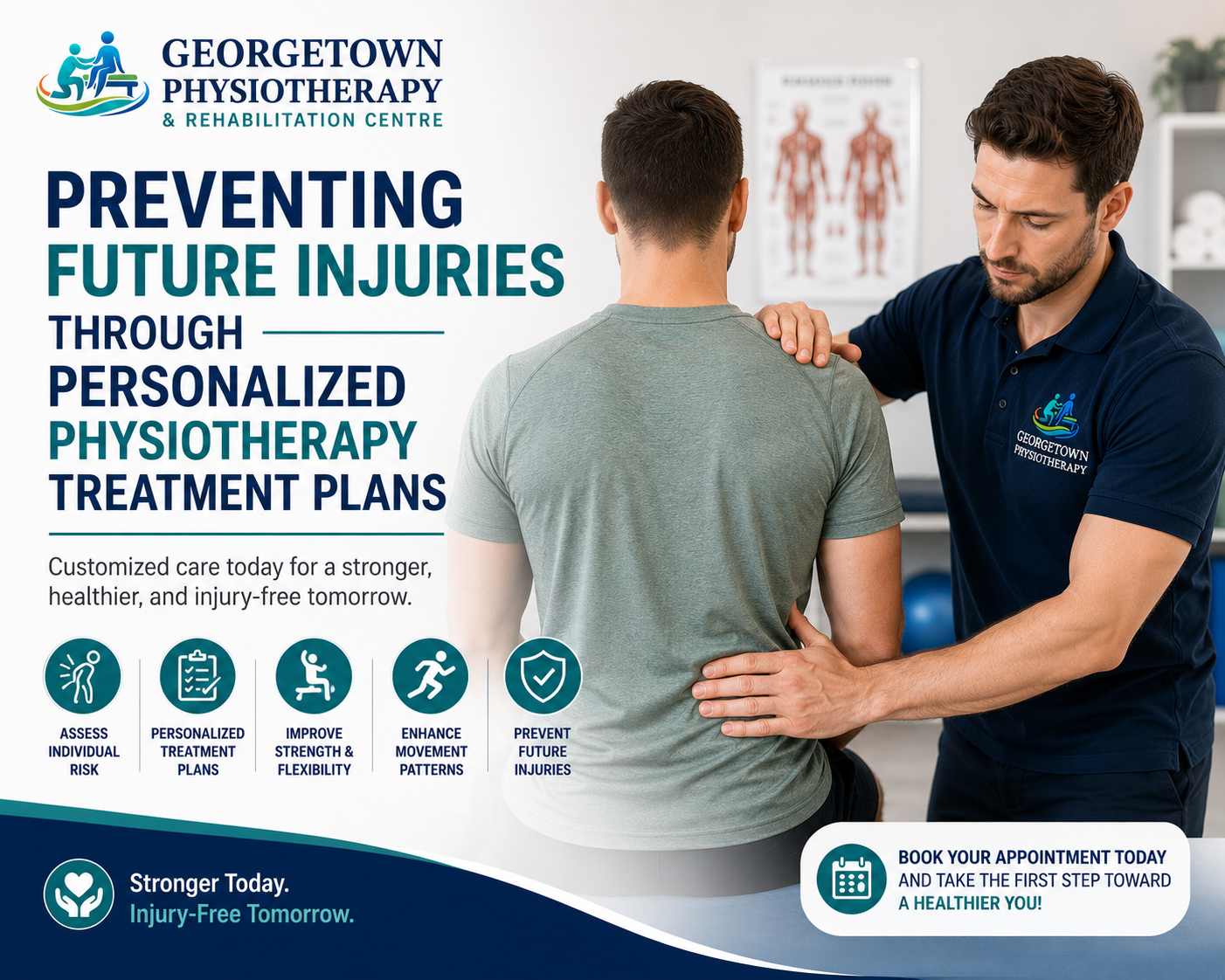
Preventing Future Injuries Through Personalized Physiotherapy Treatment Plans
Recovering from pain or an injury is often the first goal of physiotherapy—but it may not be the only goal. Once symptoms improve, many people want to know how they can return to work, sports, exercise, and everyday activities with greater confidence and reduce the chance of experiencing the same problem again.
Personalized physiotherapy treatment plans may help reduce the risk of some future injuries by addressing individual factors such as strength, mobility, balance, physical capacity, previous injuries, activity demands, and movement limitations. Instead of giving every patient the same generic exercise program, an individualized rehabilitation plan focuses on the specific abilities and challenges that matter to that person.
No physiotherapy program can guarantee that every future injury will be prevented. Accidents can happen, sports involve unpredictable situations, and many injuries have multiple contributing factors. However, building physical capacity, progressing activities appropriately, and understanding your body’s response to different demands may help reduce avoidable risks.
For people seeking personalized physiotherapy in Georgetown, an individualized approach can help connect rehabilitation with real-life goals—whether that means returning to work, playing a sport, exercising at the gym, caring for family, or simply moving more comfortably during everyday activities.
Why Is a Personalized Physiotherapy Treatment Plan Important?
Two people can experience pain in the same body part and still have very different rehabilitation needs.
Consider two people with knee pain.
One may be a recreational runner preparing to return to longer distances. The other may work in a physically demanding job that involves lifting, climbing stairs, kneeling, and standing for long periods.
Both have knee pain, but their daily demands are different.
A generic program may not fully consider:
- Previous injuries
- Current strength
- Mobility
- Balance
- Activity level
- Work demands
- Sports participation
- Exercise experience
- Recovery goals
- Tolerance for different activities
A personalized physiotherapy treatment plan starts with the individual rather than simply applying the same routine to everyone with a similar symptom.
Can Physiotherapy Prevent Future Injuries?
Physiotherapy cannot guarantee that you will never experience another injury.
Injury risk is influenced by many factors, including:
- Accidents and unexpected events
- Previous injuries
- Training demands
- Workload
- Physical capacity
- Fatigue
- Sport or job requirements
- General health
- Environmental factors
However, physiotherapy may help identify and address some modifiable factors that are relevant to an individual’s activities.
For example, a rehabilitation plan may focus on improving:
- Strength
- Mobility
- Balance
- Coordination
- Endurance
- Activity tolerance
- Confidence with movement
- Gradual return to demanding activities
The goal is not to make the body “injury-proof.” The goal is to help prepare the individual for the physical demands they expect to face.
How Does a Physiotherapist Create a Personalized Treatment Plan?
An individualized plan typically begins with an assessment.
The physiotherapist may ask about:
- Your current symptoms
- How the problem began
- Previous injuries
- Activities that are difficult
- Your occupation
- Sports and exercise
- Daily routines
- Short-term goals
- Long-term goals
A physical assessment may then examine factors relevant to your condition, such as:
- Range of motion
- Strength
- Balance
- Functional movement
- Activity tolerance
- Coordination
- Other condition-specific findings
The purpose is not simply to identify where you feel pain. It is also to understand how the problem affects your ability to perform the activities that matter to you.
1. Addressing the Effects of Previous Injuries
A previous injury can sometimes influence future activity.
After an injury, a person may experience ongoing:
- Weakness
- Reduced mobility
- Lower confidence
- Reduced activity tolerance
- Difficulty with specific movements
Some people stop rehabilitation as soon as the pain improves. However, reduced pain does not always mean that every functional goal has been achieved.
For example, an athlete may feel comfortable walking but still lack the strength or tolerance required for sprinting, jumping, or changing direction.
Similarly, a worker may feel better during normal daily activities but still find repetitive lifting or prolonged standing difficult.
A personalized treatment plan can consider these remaining functional needs before the person returns to higher-demand activities.
2. Building Strength for Real-Life Demands
Strength is an important component of physical function.
The type of strength a person needs depends on what they do.
An office worker may need sufficient endurance to tolerate prolonged desk work and daily activity.
A warehouse worker may need the capacity to lift, carry, bend, and walk repeatedly.
A runner may need strength and endurance for repeated loading over distance.
A recreational athlete may need to accelerate, decelerate, jump, land, or change direction.
A personalized physiotherapy plan can select and progress exercises according to the individual’s needs rather than using the same strengthening routine for everyone.
3. Improving Mobility Where It Matters
Mobility can influence how comfortably a person performs certain activities.
However, more flexibility is not automatically better for everyone.
The goal is to have the mobility required for the activities you need to perform.
A physiotherapist may assess whether limitations in a particular movement are relevant to your symptoms or functional goals.
When appropriate, a treatment plan may include exercises intended to improve movement in areas such as:
- Shoulders
- Neck
- Upper back
- Lower back
- Hips
- Knees
- Ankles
Mobility exercises should be selected according to the individual rather than based on a generic assumption that every person needs to stretch the same areas.
4. Improving Balance and Coordination
Balance and coordination can be important for many daily, occupational, and sporting activities.
Depending on the condition, rehabilitation may include exercises designed to challenge:
- Stability
- Body control
- Coordination
- Position awareness
- Confidence during movement
These exercises may be particularly relevant after certain lower-extremity injuries or when returning to activities that require greater movement control.
The appropriate difficulty should be progressed gradually.
5. Matching Rehabilitation to Work Demands
Injury prevention is not only relevant to athletes.
Workers may perform repetitive or physically demanding tasks every day.
Depending on the occupation, job demands may include:
- Lifting
- Carrying
- Pushing
- Pulling
- Reaching
- Bending
- Prolonged sitting
- Prolonged standing
- Repetitive movements
A personalized physiotherapy treatment plan can consider these demands.
For example, someone returning to a physically demanding job may need more than basic pain relief. Rehabilitation may also need to address strength, endurance, and tolerance for relevant work activities.
For an office worker, the focus may be different. The plan may consider prolonged desk work, movement breaks, activity levels, and strategies for managing sustained positions.
The treatment plan should reflect the person’s actual life.
6. Preparing for Sports and Exercise
Returning to sport can place demands on the body that are very different from ordinary daily activities.
Depending on the sport, an individual may need to:
- Run
- Sprint
- Jump
- Land
- Throw
- Rotate
- Change direction
- Maintain endurance
- Tolerate repeated training sessions
Feeling comfortable during everyday activities does not necessarily mean someone is prepared for all sporting demands.
A personalized rehabilitation plan can gradually progress exercises toward the activities the person wants to resume.
This progression may help identify areas that still require development before returning to higher levels of activity.
7. Progressing Activity Gradually
One common challenge after an injury is doing too much too soon.
When people begin to feel better, they may immediately return to their previous training volume, workload, or activity level.
For example, a runner who has taken several weeks away from running may try to return directly to the same distance and pace.
A worker returning after an injury may attempt to resume demanding tasks without rebuilding sufficient tolerance.
A personalized treatment plan can help structure progression.
Depending on the individual, progression may involve changes in:
- Exercise difficulty
- Resistance
- Repetitions
- Duration
- Frequency
- Speed
- Complexity
- Sport-specific or work-specific demands
The goal is to increase demands in a way that reflects the person’s current capacity and response.
8. Developing a Useful Home Exercise Program
A home exercise program can be an important part of physiotherapy.
However, more exercises are not always better.
A long list of exercises that a patient cannot realistically complete may be less useful than a focused program designed around specific goals.
A personalized home program should consider:
- The person’s condition
- Available time
- Equipment
- Exercise experience
- Current ability
- Functional goals
The program may change as the person progresses.
Exercises that were appropriate early in rehabilitation may eventually become too easy or no longer match the person’s goals.
Regular reassessment can help determine when the program should be modified.
Why Generic Exercise Programs May Fall Short
The internet provides access to thousands of exercise videos and injury-prevention routines.
General information can be useful, but a generic program cannot assess your individual situation.
The same symptom may have different contributing factors in different people.
For example, two people with shoulder discomfort may differ in:
- Range of motion
- Strength
- Work demands
- Sports participation
- Previous injuries
- Symptom behaviour
This does not mean that every person needs a complicated treatment plan. It means that exercise selection and progression should make sense for the individual.
The Role of Education in Reducing Future Injury Risk
A personalized physiotherapy plan is not only about exercises.
Education can help people better understand:
- Their symptoms
- Appropriate activity progression
- How to respond to changes in symptoms
- The difference between normal exercise effort and concerning symptoms
- The importance of recovery
- How to modify activities when needed
- When to seek further assessment
Understanding these factors may help a person make more informed decisions after formal rehabilitation ends.
Recognizing Early Warning Signs
One goal of rehabilitation may be helping patients recognize when something is changing.
This does not mean becoming afraid of every ache.
Temporary muscle soreness or fatigue can occur after unfamiliar physical activity. However, persistent or worsening symptoms, significant loss of function, or symptoms that interfere with normal activities may deserve attention.
Recognizing changes early may allow a person to:
- Adjust activity temporarily
- Review training or workload
- Return to appropriate exercises
- Seek professional assessment when necessary
The goal is informed self-management rather than fear of movement.
Common Mistakes That May Increase Injury Risk
Stopping Rehabilitation as Soon as Pain Improves
Pain reduction can be an important milestone, but it may not mean that strength, endurance, mobility, or activity tolerance have fully returned.
Returning to Full Activity Too Quickly
A sudden increase in training or physical workload may exceed current capacity.
A gradual progression can allow the body to adapt to increasing demands.
Following a One-Size-Fits-All Program
A routine designed for another person may not match your injury history, goals, or physical demands.
Ignoring Recovery
Training and activity create physical demands. Recovery is also part of the process.
Sleep, rest, nutrition, workload, and overall health can influence how a person responds to physical activity.
Focusing Only on the Painful Area
The painful area is important, but rehabilitation may also need to consider the broader movement and functional demands of the person.
Avoiding Activity Because of Fear
After an injury, some people become hesitant to move or return to activity.
When medically appropriate, gradual exposure to meaningful activities can be an important part of rebuilding function and confidence.
How Long Does a Personalized Physiotherapy Plan Take?
There is no universal timeline.
The length of rehabilitation depends on factors such as:
- The nature of the condition
- Severity of the injury
- How long symptoms have been present
- Previous injuries
- Functional limitations
- Work or sport demands
- Individual goals
- Response to rehabilitation
Someone returning to basic daily activities may have different rehabilitation requirements from an athlete preparing for competitive sport or a worker returning to a physically demanding occupation.
Progress should be evaluated according to meaningful functional goals rather than an arbitrary number of appointments.
Who May Benefit From a Personalized Physiotherapy Treatment Plan?
An individualized physiotherapy approach may be useful for people who are:
- Recovering from an injury
- Returning to sports
- Returning to physically demanding work
- Managing recurring musculoskeletal problems
- Experiencing limitations in movement or function
- Building strength after a period of reduced activity
- Preparing to resume exercise
- Looking for guidance on progressing physical activity
The appropriate treatment plan depends on the individual assessment.
Frequently Asked Questions About Personalized Physiotherapy Treatment Plans
What is a personalized physiotherapy treatment plan?
A personalized physiotherapy treatment plan is an individualized rehabilitation program based on a person’s symptoms, assessment findings, physical abilities, activity demands, and goals. It may include education, exercise, movement strategies, hands-on treatment, and progressive rehabilitation when appropriate.
Can physiotherapy guarantee that I will not be injured again?
No. No treatment can guarantee that every future injury will be prevented. Physiotherapy may help address some modifiable factors, improve physical capacity, and prepare a person for specific activities, but injuries can still occur.
Why is personalized physiotherapy different from a generic exercise program?
Personalized physiotherapy considers the individual’s condition, previous injuries, physical abilities, work demands, sports participation, goals, and response to rehabilitation. A generic program cannot assess these factors.
Can physiotherapy help after the pain is gone?
Yes, depending on the individual’s needs. Pain relief may occur before strength, endurance, mobility, confidence, or tolerance for demanding activities have fully returned. Later-stage rehabilitation may focus on these functional goals.
How often should a physiotherapy treatment plan be updated?
There is no fixed schedule that applies to everyone. A plan may be adjusted as symptoms, abilities, and goals change. Reassessment helps determine whether exercises and activities should be progressed or modified.
Is personalized physiotherapy only for athletes?
No. Personalized physiotherapy may be relevant to office workers, physically demanding occupations, older adults, recreational exercisers, people recovering from injuries, and others with movement or functional goals.
Can physiotherapy help me return to work after an injury?
Physiotherapy may support return-to-work goals by addressing relevant physical abilities such as strength, mobility, endurance, and tolerance for work-related tasks. The specific approach depends on the injury and job demands.
Personalized Physiotherapy in Georgetown
Rehabilitation should not simply focus on where you hurt. It should also consider what you need and want to do.
At Georgetown Physiotherapy & Rehabilitation Centre, physiotherapy treatment plans can be developed around individual assessment findings, functional needs, and rehabilitation goals.
Whether you are recovering from an injury, returning to work, preparing to resume exercise, or working toward greater confidence in everyday movement, an individualized approach can help make rehabilitation more relevant to your life.
Georgetown Physiotherapy & Rehabilitation Centre
333 Mountainview Rd S, Unit #2 Georgetown, ON L7G 5S5, Canada
Phone: +1 905-702-6633
Email: info@georgetownphysiotherapy.ca
Contact the clinic to learn more about physiotherapy services and appointment availability.
Build Capacity for the Activities That Matter to You
The goal of rehabilitation is not simply to complete a list of exercises. A well-designed treatment plan should connect directly to the activities that matter in your daily life.
Personalized physiotherapy treatment plans can consider your previous injuries, current abilities, work demands, sports participation, lifestyle, and individual goals. By progressively addressing relevant areas such as strength, mobility, balance, endurance, and activity tolerance, rehabilitation may help you build greater physical capacity and reduce some avoidable injury risks.
No plan can make a person completely injury-proof. However, understanding your body, progressing activity appropriately, and preparing for the demands you expect to face can provide a stronger foundation for long-term movement and function.
If you are looking for personalized physiotherapy in Georgetown, contact Georgetown Physiotherapy & Rehabilitation Centre to discuss your rehabilitation needs and request an appointment.