



 Call For Appointment
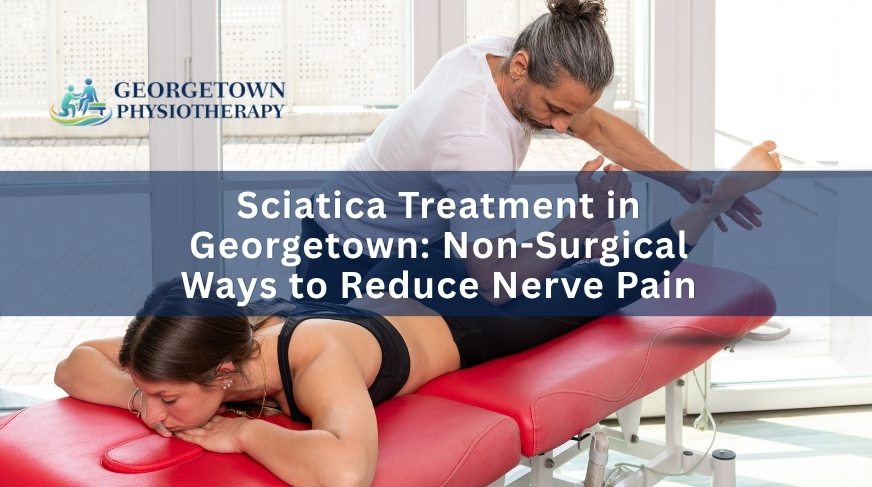
Sciatica Treatment in Georgetown: Non-Surgical Ways to Reduce Nerve Pain
Sciatica can make everyday activities surprisingly difficult. Sitting at work, driving, walking, exercising, bending, lifting, or sleeping may become uncomfortable when pain travels from the lower back or buttock into the leg.
Some people describe sciatica as a sharp, shooting, burning, or electric-like sensation. Others experience tingling, numbness, or weakness along with leg pain.
Importantly, sciatica does not automatically mean that you need surgery. Depending on the cause and severity of symptoms, non-surgical management may include education, physical activity, exercise-based rehabilitation, manual therapy where appropriate, and strategies for gradually returning to normal activities. NICE provides specific assessment and management guidance for low back pain and sciatica, while WHO recognizes rehabilitation and physical interventions as important components of managing low-back-pain conditions.
At Georgetown Physiotherapy & Rehabilitation Centre, physiotherapy can help appropriately selected patients understand their symptoms, improve physical capacity, and work toward restoring everyday function through an individualized rehabilitation plan.
Quick Answer: Can Sciatica Be Treated Without Surgery?
Yes, many people with sciatica can be managed without surgery. Treatment depends on the underlying cause, severity, duration, neurological findings, and response to conservative care.
A non-surgical rehabilitation programme may include:
- Education
- Activity modification
- Therapeutic exercise
- Strength training
- Mobility work
- Functional rehabilitation
- Manual therapy when appropriate
- Gradual return to normal activities
Surgery may still be appropriate for selected cases, particularly when symptoms remain significantly disabling despite appropriate non-surgical treatment or when serious neurological problems require specialist care.
What Is Sciatica?
Sciatica is commonly used to describe pain or other nerve-related symptoms that travel along the pathway of the sciatic nerve.
The sciatic nerve originates from nerve roots in the lower spine and travels through the buttock and down the leg.
Symptoms can include:
- Lower-back pain
- Buttock pain
- Leg pain
- Burning sensations
- Shooting pain
- Tingling
- Pins and needles
- Numbness
- Muscle weakness
WHO describes spine-related leg pain as sometimes being referred to as sciatica or radicular pain, with symptoms potentially including pain, tingling, numbness, and weakness.
Not every case of leg pain is sciatica, however. A proper clinical assessment is important before assuming that the sciatic nerve is responsible.
What Causes Sciatica?
Sciatica can have different causes.
Herniated Disc
A disc between the vertebrae can bulge or herniate and irritate a nearby nerve root.
This can produce pain or other neurological symptoms extending into the leg.
Spinal Stenosis
Changes within the spine can reduce space around nerve structures. In some people, this can contribute to leg pain or other nerve-related symptoms.
Spondylolisthesis
In certain cases, one vertebra can move relative to another and contribute to narrowing around spinal nerves.
Age-Related Changes
Discs and spinal joints naturally change over time. These changes don’t always cause symptoms, but in some people they can contribute to nerve irritation.
Injury
A sudden lifting, twisting, fall, or other physical event may trigger symptoms.
The cause matters because different presentations can require different management strategies.
How Physiotherapy Can Help Sciatica
Physiotherapy is not simply about treating the painful area.
The first priority is understanding how the symptoms are affecting your movement and function.
1. Individualized Assessment
A physiotherapist may assess:
- Pain location
- Symptom behaviour
- Lower-back movement
- Hip mobility
- Muscle strength
- Walking pattern
- Functional movement
- Neurological signs where appropriate
- Work requirements
- Exercise habits
- Previous injuries
This helps determine whether physiotherapy is appropriate and what type of rehabilitation may be beneficial.
2. Education About Your Symptoms
Uncertainty can make sciatica more difficult to manage.
You may worry:
- “Will movement damage my back?”
- “Should I stay in bed?”
- “Can I exercise?”
- “When can I return to work?”
- “Do I need surgery?”
Education can help you understand your symptoms and make informed decisions about activity.
WHO emphasizes education, self-care, physical activity, and rehabilitation as important elements of low-back-pain management.
3. Therapeutic Exercise
Exercise is an important part of many rehabilitation programmes.
Depending on your assessment, exercises may focus on:
- Core strength
- Hip strength
- Lower-body strength
- Mobility
- Balance
- Endurance
- Functional movement
There is no single “best sciatica exercise” for everyone.
An exercise that feels appropriate for one person may aggravate symptoms in another. Your programme should therefore be adjusted to your presentation and progressively modified as your capacity improves.
WHO’s guideline for chronic primary low back pain includes structured exercise programmes among non-surgical interventions that may be offered in appropriate circumstances.
4. Gradual Return to Activity
Sciatica can make people afraid to move.
But avoiding activity indefinitely can contribute to reduced strength, endurance, and confidence.
A rehabilitation programme may gradually progress from:
Comfortable movement → walking → daily activities → strengthening → work activities → exercise or sport
The exact progression depends on your symptoms and physical requirements.
The goal isn’t to force your body through pain. It is to progressively rebuild physical capacity.
5. Manual Therapy When Appropriate
Some patients may benefit from hands-on treatment as part of a broader rehabilitation programme.
Depending on the clinical assessment, this could include:
- Joint mobilization
- Soft-tissue techniques
- Movement-based manual therapy
Manual therapy should generally complement active rehabilitation rather than become the only component of treatment.
For chronic primary low back pain, WHO identifies certain physical therapies, including spinal manipulative therapy and massage, as potential components of care in appropriate contexts.
6. Strengthening for Long-Term Function
Pain reduction is only one part of recovery.
If your back, hips, and legs are not conditioned for the demands of your lifestyle, returning to normal activities may remain difficult.
Progressive strengthening may help improve your ability to:
- Lift
- Walk
- Climb stairs
- Stand
- Sit
- Exercise
- Perform household tasks
- Complete work duties
Your programme should become progressively more challenging as your physical capacity improves.
7. Work and Activity Modification
Sciatica can affect both sedentary and physically demanding occupations.
Office Workers
You may struggle with:
- Prolonged sitting
- Driving
- Standing after sitting
- Computer work
Useful strategies may include regular movement breaks and gradually improving sitting tolerance.
Physically Demanding Workers
You may have difficulty with:
- Lifting
- Carrying
- Bending
- Twisting
- Climbing
- Repetitive tasks
Your rehabilitation should eventually reflect the physical requirements of your job.
The objective is not simply to return to work—it is to build the capacity needed to perform work safely and confidently.
8. Home Strategies for Sciatica Recovery
Your actions between appointments matter.
Keep Moving Within Your Tolerance
Short walks and regular position changes may be preferable to prolonged inactivity for many people.
Avoid Long Periods in One Position
If sitting aggravates your symptoms, change positions regularly.
Follow Your Exercise Programme
Perform exercises as recommended by your physiotherapist rather than randomly selecting exercises online.
Increase Activity Gradually
Avoid suddenly returning to heavy lifting, intense exercise, or long-distance activity.
Prioritize Sleep
Poor sleep can make pain and recovery more difficult to manage.
Maintain General Physical Activity
As symptoms improve, gradually rebuild your overall physical activity level.
WHO also recommends self-management strategies such as physical activity, healthy sleep, workplace ergonomic adjustments, and maintaining participation in daily life for low-back-pain management.
Can Sciatica Go Away Without Treatment?
Some episodes of low-back and nerve-related leg pain improve over time.
WHO notes that many acute low-back-pain episodes improve on their own, although some people develop persistent symptoms.
However, “wait and see” isn’t always the best strategy.
An assessment may be particularly useful when symptoms:
- Persist
- Keep returning
- Affect work
- Interfere with sleep
- Limit walking
- Cause weakness
- Are getting worse
- Prevent normal activities
Early professional assessment can also help determine whether symptoms are appropriate for physiotherapy or require medical evaluation.
Sciatica Treatment: Physiotherapy vs Surgery
Surgery can be appropriate for some people, but it isn’t automatically required because an MRI shows a disc problem or because symptoms are severe.
NICE guidance recommends considering spinal decompression for people with sciatica when non-surgical treatment has not improved pain or function and radiological findings are consistent with their symptoms.
This means treatment decisions should consider:
- Symptoms
- Neurological findings
- Functional limitations
- Duration
- Response to conservative treatment
- Imaging findings when clinically indicated
- Individual goals
A physiotherapist can be part of the conservative-care pathway and can also identify situations where further medical assessment is appropriate.
When Is Sciatica an Emergency?
Most cases do not represent a medical emergency.
However, certain symptoms require urgent medical assessment.
Seek immediate medical attention if you develop:
- New loss of bladder or bowel control
- Numbness around the groin or saddle region
- Severe or rapidly worsening weakness
- Significant neurological deterioration
- Serious trauma associated with your symptoms
- Other concerning systemic symptoms
These can be signs of serious neurological or other medical conditions and should not be managed through routine physiotherapy alone.
NICE specifically distinguishes potentially serious neurological complications of sciatica, including progressive neurological deficit and cauda equina syndrome, from routine conservative management.
Common Mistakes People Make With Sciatica
Staying in Bed for Too Long
Extended inactivity may contribute to reduced physical capacity.
Avoiding All Movement
Fear of movement can make it harder to return to normal activities.
Returning to Heavy Exercise Too Quickly
Feeling better does not necessarily mean your strength and endurance have fully recovered.
Following Generic Exercises
Sciatica has different presentations, so a generic online programme may not be appropriate.
Ignoring Weakness or Numbness
Pain isn’t the only symptom that matters. Neurological changes should be appropriately assessed.
Expecting One Treatment to Solve Everything
A comprehensive rehabilitation plan may combine education, exercise, activity modification, and other appropriate interventions.
WHO emphasizes that a suite of interventions may be required rather than relying on a single intervention in isolation for chronic primary low back pain.
Frequently Asked Questions About Sciatica Treatment
Can physiotherapy treat sciatica without surgery?
Physiotherapy can be an appropriate non-surgical treatment option for many people with sciatica, depending on the underlying cause and clinical presentation. Treatment may include education, exercise, functional rehabilitation, and symptom-management strategies.
What is the best treatment for sciatica?
There is no single treatment that is best for every person. The appropriate approach depends on the cause, severity, neurological findings, duration, and functional limitations.
Is walking good for sciatica?
Walking may be an appropriate activity for many people, provided it is tolerated. Start with a manageable amount and gradually increase activity as symptoms and physical capacity allow.
Should I rest if I have sciatica?
Short-term activity modification can be appropriate during a flare-up, but prolonged inactivity is generally not the goal. A gradual return to appropriate activity is often part of rehabilitation.
Can massage therapy help sciatica?
Massage may help some people manage associated muscle tension or discomfort, but it should not automatically be considered a treatment for nerve compression itself. For persistent symptoms, assessment and active rehabilitation may be more appropriate.
Can chiropractic care help sciatica?
Some patients may benefit from appropriately selected manual therapy as part of conservative care. Treatment should be based on assessment and combined with active rehabilitation where appropriate.
How long does sciatica take to improve?
There is no universal recovery timeline. Symptoms vary according to the underlying cause, severity, neurological involvement, duration, and response to treatment.
When should I see a physiotherapist for sciatica?
Consider an assessment when symptoms persist, interfere with work or daily activities, repeatedly return, or are not improving as expected. New or worsening neurological symptoms should receive appropriate medical assessment.
Why Choose Georgetown Physiotherapy & Rehabilitation Centre?
At Georgetown Physiotherapy & Rehabilitation Centre, sciatica rehabilitation is approached as an individualized process rather than a one-size-fits-all treatment.
Depending on your assessment and goals, your programme may include:
- Physiotherapy
- Therapeutic Exercise
- Strength Training
- Mobility Training
- Functional Rehabilitation
- Manual Therapy
- Massage Therapy
- Chiropractic Care
- Laser Therapy
- Shockwave Therapy
- Home Exercise Programmes
- Movement Education
The aim is to help you understand your symptoms, restore physical capacity, improve function, and progressively return to the activities that matter to you.
Georgetown Physiotherapy & Rehabilitation Centre
Address: 333 Mountainview Rd S, Unit #2, Georgetown, ON L7G 5S5, Canada
Phone: +1 905-702-6633
Email: info@georgetownphysiotherapy.ca
Website: https://georgetownphysiotherapy.ca/