



 Call For Appointment

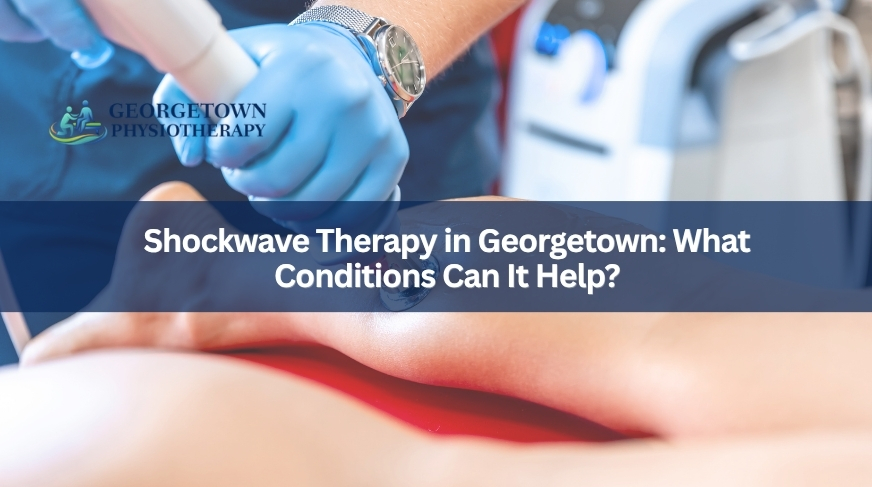
Shockwave Therapy in Georgetown: What Conditions Can It Help?
Persistent tendon or soft-tissue pain can be frustrating, especially when it continues to interfere with walking, exercise, work or everyday activities despite trying conventional approaches.
Shockwave therapy in Georgetown is one treatment option that may be considered as part of a physiotherapy and rehabilitation plan for certain musculoskeletal conditions.
Also known as extracorporeal shockwave therapy (ESWT), the treatment uses acoustic pressure waves delivered to a targeted area. It is commonly used in rehabilitation for selected tendon and soft-tissue problems, including conditions such as plantar heel pain and certain tendinopathies.
However, shockwave therapy is not appropriate for every type of pain, and it should not be viewed as a universal solution.
The first step is understanding what may be causing your symptoms and whether shockwave therapy is appropriate for your particular condition.
What Is Shockwave Therapy?
Shockwave therapy is a non-invasive treatment that delivers acoustic waves to a targeted area of the body.
It may be used as part of rehabilitation for certain persistent tendon and musculoskeletal conditions. The treatment is generally selected following an assessment rather than simply based on the location of pain.
For some patients, shockwave therapy may be combined with therapeutic exercise, activity modification, education and other physiotherapy techniques.
The appropriate treatment depends on the individual’s condition, symptoms, goals and clinical assessment.
How Does Shockwave Therapy Work?
Shockwave therapy uses acoustic waves that are delivered through a treatment applicator placed against the skin.
The goal is to influence the tissues in the targeted area and support the body’s rehabilitation response.
Shockwave therapy has been used in medicine for decades and has developed beyond its original applications into musculoskeletal rehabilitation.
It is important, however, to avoid thinking of shockwave therapy as simply “breaking up pain.”
The treatment is generally one component of a broader rehabilitation strategy.
For tendon-related problems in particular, an appropriate exercise and loading program may remain an important part of recovery.
What Conditions Can Shockwave Therapy Help?
The conditions for which shockwave therapy may be considered vary depending on the individual and the type of shockwave treatment being used.
Some commonly discussed applications include:
1. Plantar Fasciitis and Persistent Heel Pain
Plantar heel pain can make walking, standing and exercise uncomfortable.
Some rehabilitation programs use shockwave therapy for persistent plantar fasciitis or plantar heel pain, particularly when symptoms have not improved sufficiently with other approaches.
Treatment may be combined with exercises and advice designed around the individual’s foot, ankle and activity needs.
If you have heel pain, it is important to determine whether plantar fasciitis is actually the cause before starting treatment.
Other foot and ankle conditions can produce similar symptoms.
2. Achilles Tendon Problems
The Achilles tendon connects the calf muscles to the heel and plays an important role in walking, running and jumping.
Persistent Achilles tendon pain can affect both active individuals and people who do not participate in sport.
Shockwave therapy may be considered for certain Achilles tendinopathies as part of a broader rehabilitation plan.
Exercise-based tendon loading and gradual return to activity may also be important components of treatment.
3. Tennis Elbow
Despite its name, tennis elbow does not only affect tennis players.
It generally refers to pain around the outer elbow associated with the extensor tendons of the forearm.
People may experience discomfort when:
- Gripping objects
- Lifting
- Using a computer mouse
- Turning a handle
- Playing racquet sports
- Performing repetitive work
Shockwave therapy may be considered in selected persistent cases following assessment.
Your physiotherapist may also address forearm strength, tendon loading, activity modification and movement patterns.
4. Patellar Tendon Problems
The patellar tendon connects the kneecap to the shinbone and plays an important role in activities involving the knee.
Persistent patellar tendon pain can occur in people involved in jumping sports and other physically demanding activities.
Shockwave therapy is sometimes incorporated into rehabilitation for selected tendon conditions.
However, treatment should be based on the individual’s symptoms and assessment rather than simply applying the same protocol to everyone with knee pain.
5. Certain Shoulder Tendon Conditions
Some shoulder tendon problems may be considered for shockwave therapy.
One example is calcific tendinopathy of the shoulder.
This condition involves calcium deposits within a tendon and can cause pain and restricted shoulder movement.
Shockwave therapy has been used in the management of calcific shoulder tendon problems, but the suitability of treatment depends on the individual diagnosis and clinical findings.
Shoulder pain can have many different causes, so assessment is particularly important before choosing a treatment.
6. Other Tendon and Soft-Tissue Problems
Shockwave therapy may also be considered for selected musculoskeletal conditions involving tendons or soft tissues.
Examples discussed in rehabilitation literature and clinical practice include certain:
- Achilles tendon conditions
- Patellar tendon conditions
- Lateral elbow tendon problems
- Plantar heel pain
- Other chronic tendinopathies
Not every condition responds in the same way, and treatment recommendations should be individualized.
Is Shockwave Therapy Right for Everyone?
No.
One of the most important points to understand about shockwave therapy is that having pain in a particular body part does not automatically mean shockwave therapy is appropriate.
For example, two people may both have heel pain.
One may have plantar fasciitis.
Another may have a stress injury, nerve-related symptoms, an inflammatory condition or another problem requiring a different approach.
This is why a physiotherapy assessment should come before deciding whether shockwave therapy is appropriate.
What Happens During an Assessment?
An assessment may begin with a discussion about your symptoms.
Your physiotherapist may ask about:
- When your symptoms started
- Whether there was an injury
- Activities that increase symptoms
- Your work demands
- Sports or exercise
- Previous treatment
- Your current activity level
- Your recovery goals
A physical assessment may then look at movement, strength, flexibility, functional limitations and other relevant factors.
The purpose is not simply to locate where you feel pain.
It is to develop a better understanding of the problem and determine whether shockwave therapy should be part of your rehabilitation plan.
What Does Shockwave Treatment Feel Like?
The sensation varies between individuals and depends on the treatment area, condition and intensity being used.
The device delivers repeated pulses to the targeted area. Some people describe the sensation as tapping, pressure or discomfort.
Treatment intensity can generally be adjusted according to clinical circumstances and patient tolerance.
It is useful to tell your physiotherapist how the treatment feels during the session.
The goal is to use an appropriate treatment intensity rather than assuming that stronger treatment is always better.
How Many Shockwave Therapy Sessions Are Needed?
There is no single number of sessions that applies to every patient.
Treatment frequency and duration can depend on:
- The condition being treated
- How long symptoms have been present
- Treatment response
- Clinical assessment
- The overall rehabilitation plan
Some clinical programs use a series of treatments rather than a single session. For example, one physiotherapy provider describes courses of three to six sessions for selected tendon problems, but treatment schedules vary between individuals and clinics.
Therefore, patients should not assume that a specific number of treatments is guaranteed to produce a particular result.
Your physiotherapist can discuss an appropriate plan after assessment.
Does Shockwave Therapy Replace Exercise?
Usually, shockwave therapy should not be viewed as a replacement for rehabilitation exercise.
For many tendon-related conditions, appropriately selected loading and strengthening exercises are an important part of rehabilitation.
Shockwave therapy may be used alongside exercise rather than instead of it.
This distinction is important.
The objective is not simply to provide a treatment session and then return to the same activities that contributed to the problem without addressing strength, loading capacity or movement requirements.
A complete rehabilitation plan may include:
- Therapeutic exercise
- Strengthening
- Mobility work
- Activity modification
- Education
- Gradual return to activity
- Shockwave therapy when appropriate
What Are the Potential Benefits?
Depending on the condition and individual response, shockwave therapy may be used to support:
- Pain management
- Functional improvement
- Rehabilitation progress
- Tendon-related recovery
- Return to activity
However, outcomes vary.
No responsible treatment plan should guarantee that shockwave therapy will eliminate pain or produce a particular recovery timeline.
The evidence and clinical application differ between conditions, which is another reason an individualized assessment matters.
Are There Side Effects?
Shockwave therapy can cause temporary discomfort during or after treatment.
Some people may experience temporary tenderness or soreness around the treated area.
Your physiotherapist should explain what you can reasonably expect based on the treatment being considered for you.
Tell your healthcare provider about relevant medical conditions, medications, recent injuries and other factors before treatment.
What Should You Do After Treatment?
Your post-treatment recommendations depend on the condition and treatment plan.
Your physiotherapist may provide advice regarding activity, exercise and loading.
For tendon conditions, rehabilitation often involves gradually building the tissue’s capacity to tolerate the activities you want to return to.
This means that simply reducing pain is not necessarily the final goal.
The longer-term goal may be improving function and helping you return to meaningful activities.
Shockwave Therapy vs Traditional Physiotherapy
It is not always useful to think of shockwave therapy and physiotherapy as two competing options.
Shockwave therapy can be incorporated into physiotherapy when clinically appropriate.
A broader physiotherapy program may address:
Pain: Understanding what aggravates symptoms and how they can be managed.
Mobility: Addressing relevant restrictions.
Strength: Improving the capacity of muscles and tissues.
Loading: Gradually increasing tolerance to activity.
Function: Working toward everyday, work or sporting goals.
Education: Understanding the condition and managing it between appointments.
This combined approach can be more meaningful than focusing on one treatment technique alone.
Who Might Consider Shockwave Therapy in Georgetown?
Shockwave therapy may be worth discussing with a physiotherapist if you have a persistent musculoskeletal problem that has not improved as expected.
Examples may include persistent:
- Heel pain
- Achilles tendon pain
- Tennis elbow
- Patellar tendon pain
- Certain shoulder tendon conditions
However, these symptoms can have different causes.
An assessment is therefore important before deciding whether shockwave therapy is appropriate.
Why Assessment Comes First
Choosing treatment based only on a symptom can lead to the wrong approach.
For example, “heel pain” is a symptom rather than a diagnosis.
The same applies to:
A physiotherapist can assess the presentation and determine whether the symptoms are consistent with a condition for which shockwave therapy may be appropriate.
If not, another treatment approach may be more suitable.
Frequently Asked Questions
What is shockwave therapy?
Shockwave therapy uses acoustic pressure waves delivered to a targeted area of the body. It may be incorporated into rehabilitation for selected musculoskeletal and tendon-related conditions.
Is shockwave therapy painful?
The sensation varies. Some people experience discomfort during treatment, particularly around sensitive areas. Treatment intensity can be adjusted according to the individual and clinical situation.
Can shockwave therapy help plantar fasciitis?
Shockwave therapy may be considered for persistent plantar heel pain or plantar fasciitis in selected patients. Assessment is important because not every cause of heel pain requires shockwave therapy.
Can shockwave therapy help tennis elbow?
It may be considered for selected cases of persistent lateral elbow tendon pain. A physiotherapy assessment can help determine whether it is appropriate.
Can shockwave therapy help Achilles tendon pain?
Shockwave therapy may be considered for certain Achilles tendon conditions, generally as part of a broader rehabilitation plan that may include progressive exercise and activity modification.
Does shockwave therapy replace physiotherapy exercises?
No. Shockwave therapy may be incorporated into a rehabilitation program, but exercise and appropriate loading can remain important components of recovery for many tendon conditions.
How many shockwave therapy sessions will I need?
The number varies according to the condition, symptoms and response to treatment. Your physiotherapist can recommend an appropriate treatment plan after assessment.
Is shockwave therapy suitable for all types of pain?
No. Shockwave therapy is not appropriate for every condition or every patient. Assessment should be used to determine whether it is clinically suitable.
Shockwave Therapy in Georgetown: Start With an Assessment
If persistent tendon or musculoskeletal pain is affecting your walking, exercise, work or everyday activities, shockwave therapy may be one treatment option worth discussing with a physiotherapist.
The important first step is not choosing a treatment simply because it is available.
It is understanding what is causing your symptoms and whether shockwave therapy is appropriate for your condition and goals.
At Georgetown Physiotherapy & Rehabilitation Centre, an individualized assessment can help determine an appropriate rehabilitation approach based on your symptoms, movement limitations and functional goals.
Georgetown Physiotherapy & Rehabilitation Centre
333 Mountainview Rd S, Unit #2Georgetown, ON L7G 5S5
Phone: +1 905 702 6633
Email: info@georgetownphysiotherapy.ca
If you’re considering shockwave therapy in Georgetown, contact the clinic to discuss an assessment and determine whether this treatment may be appropriate for your rehabilitation needs.