



 Call For Appointment
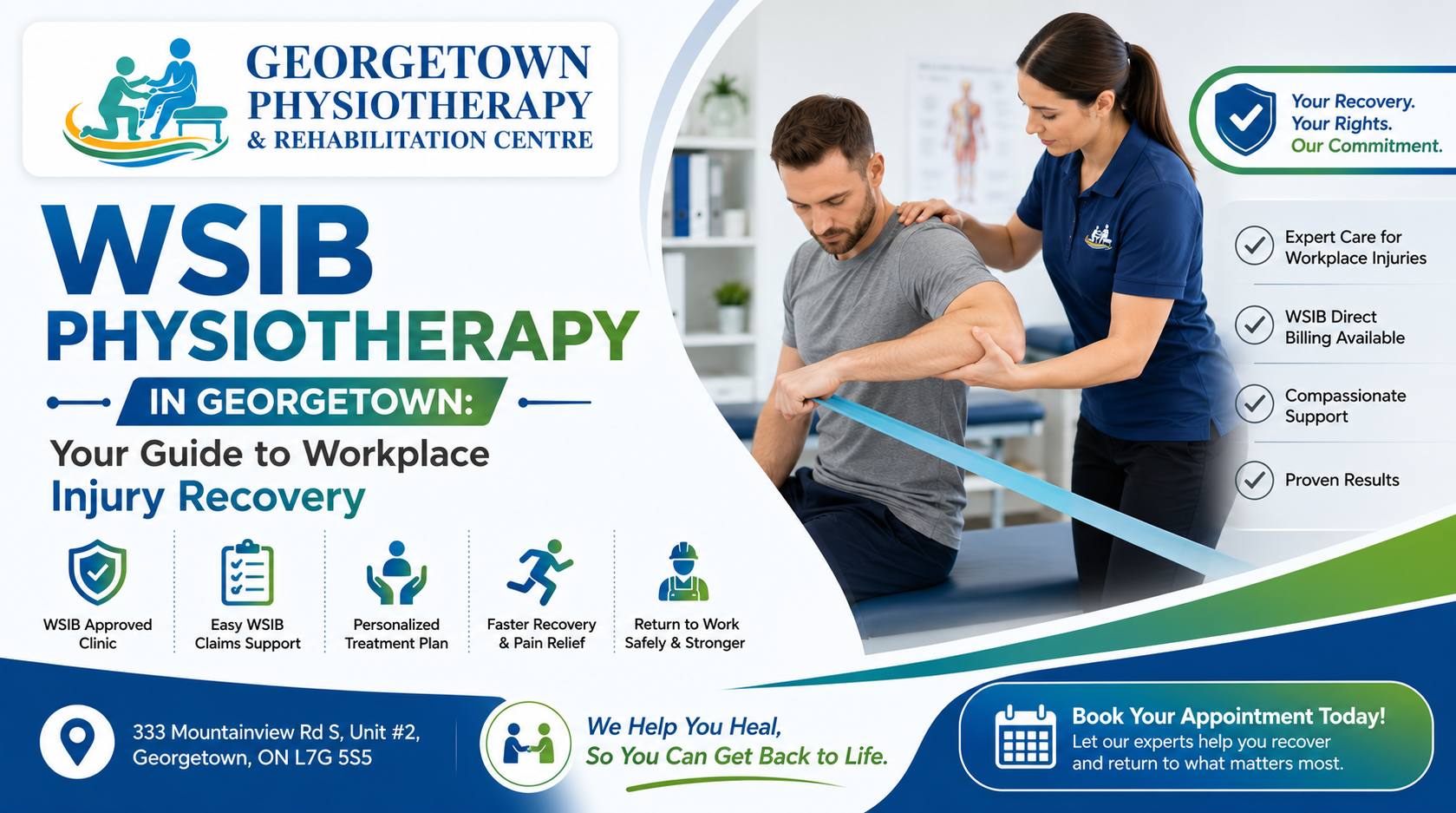
WSIB Physiotherapy in Georgetown: Your Guide to Workplace Injury Recovery
A workplace injury can happen when you least expect it. Whether you work in construction, manufacturing, healthcare, transportation, retail, warehousing, or an office environment, an injury can affect your ability to work, perform daily activities, and enjoy your normal routine.
Fortunately, many work-related musculoskeletal injuries respond well to early assessment and rehabilitation. Physiotherapy is often an important part of workplace injury recovery, helping individuals restore movement, improve strength, manage pain, and safely return to suitable work. The Ontario Workplace Safety and Insurance Board (WSIB) supports evidence-informed rehabilitation and emphasizes recovery alongside a safe and sustainable return to work.
At Georgetown Physiotherapy & Rehabilitation Centre, we provide personalized rehabilitation for patients with approved or pending WSIB claims. Our experienced team works with injured workers to develop individualized treatment plans focused on functional recovery and helping them return to their work and daily activities as safely as possible.
What Is WSIB Physiotherapy?
The Workplace Safety and Insurance Board (WSIB) provides workplace injury insurance and rehabilitation support for eligible workers in Ontario.
If you sustain a work-related injury or illness, you may be eligible for physiotherapy covered through your WSIB claim, depending on your claim status and eligibility. WSIB’s musculoskeletal program is designed to provide timely, evidence-informed assessment and treatment while supporting a safe return to work.
The overall goals include:
- Reducing pain
- Restoring movement
- Improving strength
- Supporting functional recovery
- Helping workers safely return to suitable work
- Preventing prolonged disability
Common Workplace Injuries That May Benefit From Physiotherapy
Many workplace injuries involve the muscles, joints, tendons, ligaments, and other soft tissues.
Examples include:
- Back injuries
- Neck pain
- Shoulder injuries
- Knee injuries
- Sprains and strains
- Repetitive strain injuries
- Tendon injuries
- Muscle injuries
- Lifting injuries
- Slips, trips, and falls
- Work-related joint pain
Each injury is different, so rehabilitation should always be based on an individualized assessment rather than a standard treatment plan.
Why Early Physiotherapy Matters
After a workplace injury, many people assume complete rest is the best solution.
While short-term protection may be appropriate for some injuries, prolonged inactivity is not beneficial for many musculoskeletal conditions.
Current WSIB guidance supports timely rehabilitation and a gradual return to safe, suitable work when medically appropriate because movement and functional recovery often progress together.
Early physiotherapy may help:
- Reduce pain
- Improve mobility
- Restore strength
- Prevent excessive stiffness
- Improve confidence with movement
- Support a smoother return to work
What Happens During Your First WSIB Physiotherapy Appointment?
Your first appointment focuses on understanding both your injury and the physical demands of your job.
Your physiotherapist may assess:
- How the injury occurred
- Your current symptoms
- Pain location
- Joint mobility
- Muscle strength
- Balance
- Functional movement
- Work duties
- Previous injuries
- Recovery goals
Understanding your workplace tasks is essential because rehabilitation should prepare you for the physical demands of your occupation.
Your Personalized Rehabilitation Plan
Following your assessment, your physiotherapist develops an individualized treatment program.
Depending on your condition, treatment may include:
- Therapeutic exercise
- Manual therapy
- Movement education
- Stretching
- Strengthening exercises
- Balance training
- Functional training
- Laser therapy where appropriate
- Shockwave therapy where clinically indicated
- Home exercise program
Treatment is regularly adjusted according to your recovery and functional progress.
Functional Recovery Is the Goal
WSIB rehabilitation focuses on more than simply reducing pain.
The objective is helping you safely perform the physical requirements of your work.
For example, rehabilitation may prepare workers to:
- Lift safely
- Carry equipment
- Climb stairs
- Push or pull loads
- Reach overhead
- Stand for prolonged periods
- Walk comfortably
- Return to repetitive work activities
Treatment should reflect the actual demands of your occupation.
Returning to Work Safely
One of the most important parts of WSIB rehabilitation is return-to-work planning.
Research consistently shows that returning to safe and suitable work—when medically appropriate—can support recovery and improve long-term outcomes. A full recovery is not always required before beginning modified duties, provided the work matches your functional abilities.
Depending on your progress, your physiotherapist may help identify:
- Current functional abilities
- Temporary limitations
- Activity restrictions
- Progress toward work goals
This information can support communication with the broader return-to-work process when required.
Workplace Injuries Commonly Seen in Physiotherapy
Back Injuries
Heavy lifting, repetitive bending, prolonged standing, and awkward movements frequently contribute to workplace back pain.
Rehabilitation often focuses on restoring movement, strengthening supporting muscles, and improving lifting mechanics.
Neck Pain
Office workers, drivers, healthcare professionals, and manufacturing employees commonly develop work-related neck pain.
Treatment may include mobility exercises, strengthening, posture education, and movement strategies.
Shoulder Injuries
Overhead work, repetitive reaching, lifting, and manual labour can place considerable stress on the shoulder.
Physiotherapy may help improve mobility, strength, and functional capacity.
Knee Injuries
Construction workers, warehouse employees, tradespeople, and healthcare workers often place high physical demands on their knees.
Rehabilitation may include strengthening, balance training, mobility exercises, and work-specific functional activities.
Can Physiotherapy Help Prevent Re-Injury?
A successful rehabilitation program focuses on more than recovering from the current injury.
Your physiotherapist may also provide education on:
- Safe lifting strategies
- Body mechanics
- Exercise progression
- Workplace movement
- Strengthening
- Flexibility
- Injury prevention strategies
These recommendations are designed to support long-term function and reduce avoidable injury risks.
Common Questions About WSIB Physiotherapy
Do I Need a Referral?
Ontario workers generally have the right to choose their initial treating health professional, including a physiotherapist, for a work-related injury within the provider’s scope of practice.
Will WSIB Cover Physiotherapy?
Coverage depends on your claim eligibility and approval. If your workplace injury claim is accepted—or in some situations while it is pending under applicable programs—physiotherapy may be covered according to WSIB policies.
How Long Will Rehabilitation Take?
Recovery timelines vary based on:
- The type of injury
- Severity
- Job demands
- Overall health
- Functional goals
- Individual response to treatment
Your physiotherapist will monitor your progress and modify your treatment plan as needed.
Tips for a Successful Recovery
To support your rehabilitation:
- Attend scheduled appointments consistently.
- Complete your prescribed home exercise program.
- Communicate changes in your symptoms.
- Follow activity recommendations from your healthcare team.
- Return to work according to your recommended functional abilities.
- Ask questions whenever you are unsure about your rehabilitation plan.
Why Choose Georgetown Physiotherapy & Rehabilitation Centre?
At Georgetown Physiotherapy & Rehabilitation Centre, we understand that every workplace injury is unique.
Our team provides individualized, evidence-informed rehabilitation designed to help patients recover safely and confidently. Depending on your assessment, your treatment plan may include physiotherapy, manual therapy, exercise therapy, laser therapy, shockwave therapy, massage therapy, and education tailored to your specific job requirements.
Georgetown Physiotherapy & Rehabilitation Centre
Address: 333 Mountainview Rd S, Unit #2, Georgetown, ON L7G 5S5, Canada
Phone: +1 905-702-6633
Email: info@georgetownphysiotherapy.ca
Website: https://georgetownphysiotherapy.ca/
Begin Your Recovery With Confidence
A workplace injury doesn’t have to keep you away from the activities and career you enjoy.
Early assessment, individualized physiotherapy, and a structured rehabilitation program can play an important role in helping you recover, rebuild strength, and safely return to suitable work.
If you are looking for WSIB physiotherapy in Georgetown, Georgetown Physiotherapy & Rehabilitation Centre is here to support you through every stage of your rehabilitation with compassionate, evidence-informed care focused on your recovery and long-term well-being.