



 Call For Appointment
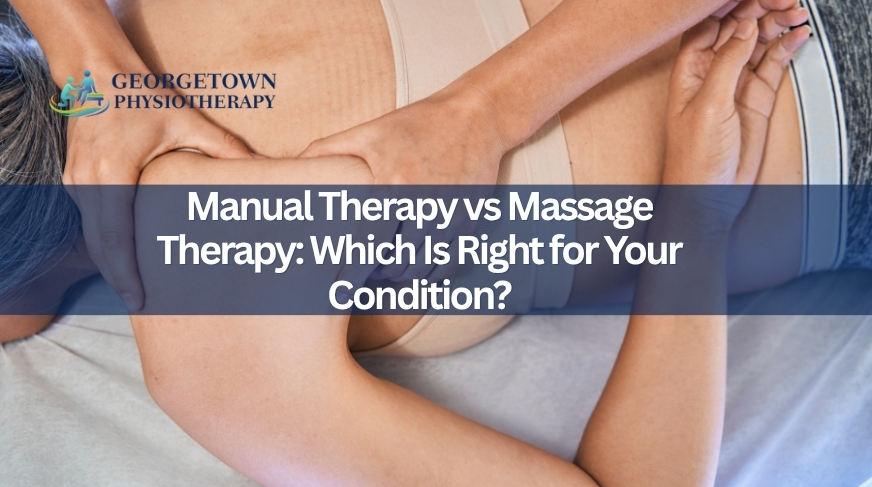
Manual Therapy vs Massage Therapy: Which Is Right for Your Condition?
When you’re dealing with muscle tension, stiffness, pain, or reduced mobility, choosing the right type of hands-on treatment can be confusing.
You may have heard about manual therapy and massage therapy and wondered whether they are essentially the same thing.
They aren’t.
Although both may involve hands-on techniques and can sometimes be used together, manual therapy and massage therapy have different clinical purposes, treatment approaches, and contexts of use.
Manual therapy is generally used as part of a broader physiotherapy or rehabilitation plan and can involve specific techniques directed at joints, muscles, and other soft tissues. Massage therapy primarily uses hands-on soft-tissue techniques to address goals such as relaxation, muscle tension, and symptom management.
Neither option is automatically “better.” The appropriate choice depends on why you are seeking treatment, your symptoms, physical limitations, medical history, and recovery goals.
At Georgetown Physiotherapy & Rehabilitation Centre, treatment can be tailored to your individual needs, with physiotherapy, manual therapy, massage therapy, exercise-based rehabilitation, chiropractic care, and other services available as clinically appropriate.
Quick Answer: Manual Therapy vs Massage Therapy
Manual therapy is typically a targeted hands-on component of physiotherapy or rehabilitation designed to address specific movement, joint, or soft-tissue problems. Massage therapy is primarily focused on hands-on soft-tissue treatment, relaxation, muscle tension, and symptom management.
For someone recovering from an injury or dealing with movement limitations, manual therapy may be combined with therapeutic exercise and functional rehabilitation. Someone primarily seeking relaxation or management of generalized muscle tension may find massage therapy more appropriate.
In many situations, the two approaches can complement each other rather than being competing choices.
Evidence also suggests that hands-on treatments are generally most useful when selected according to the individual’s condition and incorporated into an appropriate overall care plan rather than treated as a universal solution.
What Is Manual Therapy?
Manual therapy is a broad term describing hands-on techniques used by trained healthcare professionals to assess or influence movement, pain, and soft-tissue or joint function.
In physiotherapy, manual therapy can include techniques such as:
- Joint mobilization
- Soft-tissue techniques
- Specific manual stretching
- Joint manipulation where appropriate
- Muscle and tissue techniques
- Movement-assisted techniques
The exact technique depends on the patient’s condition.
Importantly, manual therapy isn’t necessarily intended to be the entire treatment.
Modern physiotherapy commonly combines hands-on treatment with:
- Therapeutic exercise
- Education
- Activity modification
- Strength training
- Mobility exercises
- Functional rehabilitation
The American Physical Therapy Association describes manual therapy as specific hands-on techniques that may manipulate or mobilize joints and muscles and notes that it is often used alongside other activities to improve movement.
What Is Massage Therapy?
Massage therapy involves hands-on techniques applied primarily to soft tissues such as muscles and surrounding structures.
Depending on the treatment and individual’s goals, massage may include:
- Swedish massage
- Therapeutic massage
- Deep-tissue techniques
- Myofascial techniques
- Trigger-point techniques
- Stretching
People may seek massage therapy for:
- Muscle tension
- Stress
- Relaxation
- Exercise recovery
- General physical discomfort
- Short-term symptom relief
Research on massage therapy varies by condition. The National Center for Complementary and Integrative Health notes that massage may provide short-term benefits for some types of neck, shoulder, and low-back pain, although the strength of evidence varies and isn’t equally strong for all conditions.
Manual Therapy vs Massage Therapy: Key Differences
| Manual Therapy | Massage Therapy |
|---|---|
| Often part of physiotherapy or rehabilitation | Primarily hands-on soft-tissue treatment |
| Can target joints and soft tissues | Primarily targets soft tissues |
| Often linked to a specific functional problem | Often focused on tension, relaxation, and comfort |
| May include joint mobilization | Usually emphasizes massage techniques |
| Frequently combined with exercise | May be combined with exercise or other care |
| Often used within an injury rehabilitation plan | Can be used for wellness, tension, and recovery |
| Treatment is guided by clinical assessment | Treatment is guided by health history and massage assessment |
There is overlap between the two, but their purpose and clinical context can differ significantly.
When Might Manual Therapy Be Appropriate?
Manual therapy may be considered when a person has a specific movement or musculoskeletal problem.
For example:
Neck Stiffness
A physiotherapist may assess neck mobility and determine whether manual techniques could complement mobility exercises and strengthening.
Back Pain
Manual therapy may be incorporated into a broader programme involving exercise, education, and gradual return to normal activities.
Joint Stiffness
Specific mobilization techniques may be used where appropriate to support movement.
Sports Injuries
Manual therapy may sometimes be used alongside progressive strengthening and sport-specific rehabilitation.
Post-Injury Rehabilitation
Following an appropriate assessment, manual techniques may help address certain movement limitations while active rehabilitation rebuilds physical capacity.
The important point is that manual therapy should be selected because it fits the person’s clinical presentation—not simply because hands-on treatment feels good.
When Might Massage Therapy Be Appropriate?
Massage therapy may be appropriate for people seeking help with muscle tension, relaxation, physical comfort, or recovery.
Common reasons include:
Stress-Related Muscle Tension
Stress can be associated with increased muscle tension, particularly around the neck and shoulders.
Massage may provide a period of relaxation and help some people feel less tense.
Exercise Recovery
Active adults may use massage as one component of their broader recovery routine.
General Muscle Tightness
People who spend long periods sitting or performing repetitive physical tasks may experience muscle tension.
Wellness and Relaxation
Massage doesn’t have to be associated with an injury. Some people simply seek it as part of their overall wellness routine.
However, persistent or unexplained pain shouldn’t automatically be treated with massage alone. NCCIH specifically advises against using massage to postpone appropriate medical evaluation.
Which Is Better for Back Pain?
There isn’t one universal answer.
The appropriate approach depends on the type of back pain, duration, symptoms, physical limitations, and individual goals.
For someone with uncomplicated muscle tension who primarily wants short-term relaxation, massage may be reasonable.
For someone experiencing recurring back pain with weakness, reduced mobility, or difficulty performing work or exercise, physiotherapy may provide a broader rehabilitation strategy.
Physiotherapy may combine:
- Manual therapy
- Exercise
- Strengthening
- Mobility work
- Education
- Functional training
Clinical practice guidelines for physical therapy management of low-back pain include interventions such as therapeutic exercise and manual therapy within appropriate treatment plans.
Which Is Better for Neck Pain?
Again, it depends on the underlying problem.
Massage may provide short-term relief for some people with neck and shoulder discomfort. NCCIH reports that massage can be helpful for some neck or shoulder pain, although benefits may be short-lived.
Manual therapy may be considered when a physiotherapist identifies specific mobility or musculoskeletal issues.
A broader physiotherapy programme may additionally address:
- Neck mobility
- Shoulder strength
- Upper-back strength
- Postural endurance
- Workstation habits
- Movement breaks
- Exercise
This is particularly relevant for people whose neck pain repeatedly returns.
What About Sports Injuries?
Sports injuries often require more than hands-on treatment.
An athlete may initially benefit from symptom-management strategies, but long-term recovery usually requires rebuilding the physical capacity needed for their sport.
That may include:
- Strength
- Mobility
- Balance
- Coordination
- Endurance
- Power
- Sport-specific movements
Manual therapy may be one component of the programme.
Massage may also be used to manage muscle tension or perceived soreness.
But neither should automatically replace active rehabilitation.
Manual Therapy vs Massage Therapy for Muscle Tension
This is one area where there can be considerable overlap.
If your primary concern is generalized muscle tightness, massage may be a suitable option.
If muscle tension is associated with a specific movement limitation, injury, or recurring functional problem, physiotherapy assessment may be more useful.
For example:
Neck tension + relaxation goal → Massage may be appropriate
Neck tension + reduced movement + recurring pain → Physiotherapy assessment may be more appropriate
Sports injury + weakness + reduced function → Rehabilitation-focused physiotherapy
The key is identifying why the tension is occurring, rather than simply treating the sensation of tightness.
Can You Have Both Manual Therapy and Massage Therapy?
Yes, when clinically appropriate.
In fact, they can complement each other.
For example, a person with recurring shoulder discomfort may receive:
Physiotherapy assessment → manual therapy → mobility exercises → strengthening → massage for muscle tension
The exact combination depends on the individual.
Massage can help address soft-tissue comfort, while physiotherapy can focus on strength, movement, function, and long-term physical capacity.
Why Exercise Still Matters
One of the most important differences between a passive treatment and an active rehabilitation programme is what happens between appointments.
Hands-on treatment may provide short-term improvements in pain or comfort.
But if the underlying physical capacity hasn’t improved, symptoms may return when normal activities resume.
A physiotherapist may therefore prescribe:
- Strength exercises
- Mobility exercises
- Balance exercises
- Functional training
- Conditioning
- Home exercises
The American Physical Therapy Association’s patient guidance emphasizes that physical therapy commonly combines manual therapy with movement, exercise, education, and graded activity according to individual needs.
A Simple Decision Guide
Use this as a starting point—not as a diagnosis.
Choose Massage Therapy When:
- Your main goal is relaxation
- You have general muscle tension
- You want soft-tissue treatment
- You’re looking for recovery support after physical activity
- You don’t have unexplained or concerning symptoms
Consider Physiotherapy With Manual Therapy When:
- You have persistent pain
- Your movement is restricted
- You have muscle weakness
- You’ve experienced an injury
- You have recurring symptoms
- Work or sport is affected
- You need a structured rehabilitation programme
Seek Medical Assessment First When:
- Pain follows major trauma
- You have significant weakness
- You develop new numbness
- You experience loss of bladder or bowel control
- You have unexplained severe symptoms
- Symptoms are rapidly worsening
Common Mistakes When Choosing Between the Two
Choosing Based Only on Pressure
A stronger massage isn’t necessarily a better treatment.
Treatment intensity should be appropriate for your condition.
Treating the Symptom Instead of the Cause
If your shoulder keeps becoming tight, repeatedly treating the tightness without assessing contributing factors may not address the reason it keeps returning.
Expecting One Session to Fix a Chronic Problem
Long-standing problems may require an ongoing combination of exercise, education, activity modification, and appropriate hands-on care.
Avoiding Exercise Completely
Hands-on treatment can be useful, but active rehabilitation is often important for rebuilding physical capacity.
Ignoring Persistent Pain
If symptoms don’t improve or continue returning, consider an appropriate clinical assessment rather than repeatedly relying on temporary relief.
What Happens During a Physiotherapy Assessment?
If you choose physiotherapy, the process typically begins with an assessment rather than immediately selecting a treatment technique.
Your physiotherapist may discuss:
- Your symptoms
- Injury history
- Work activities
- Exercise habits
- Previous treatment
- Functional limitations
- Recovery goals
They may assess:
- Range of motion
- Strength
- Balance
- Movement
- Joint mobility
- Functional tasks
The findings help determine whether manual therapy, exercise, education, massage, or another approach is appropriate.
What Happens During a Massage Therapy Appointment?
A massage appointment generally begins with a discussion of your health history, symptoms, physical activity, and treatment goals.
Your therapist may ask about:
- Areas of tension
- Previous injuries
- Medical conditions
- Physical activity
- Work demands
- Treatment preferences
The treatment can then be adapted according to your needs and tolerance.
Communication matters. If pressure causes significant discomfort, tell your therapist so the technique can be modified.
How Long Does the Benefit Last?
This varies substantially between people and conditions.
Massage research suggests that benefits for some pain conditions may be relatively short-term.
Manual therapy can also provide symptom or movement improvements, but it shouldn’t necessarily be viewed as a permanent solution on its own.
Longer-term improvement often depends on what happens after the hands-on treatment.
That may include:
Exercise + physical activity + strength + mobility + education + appropriate workload management
This is why a good rehabilitation programme focuses on helping patients become more capable—not dependent on repeated passive treatment.
Frequently Asked Questions
Is manual therapy the same as massage therapy?
No. Both use hands-on techniques, but manual therapy is commonly used as part of physiotherapy or rehabilitation and may target joints, movement, and soft tissues. Massage therapy primarily uses soft-tissue techniques for goals such as relaxation, muscle tension, and comfort.
Is massage better than manual therapy for muscle tension?
Not necessarily. Massage may be appropriate for generalized muscle tension and relaxation, while physiotherapy assessment may be more useful when tension is associated with an injury, movement restriction, weakness, or recurring symptoms.
Can manual therapy help back pain?
It may help some people when appropriately selected and combined with other rehabilitation strategies. Manual therapy is commonly considered alongside exercise and education rather than as an isolated treatment.
Can massage help neck pain?
Massage may provide short-term relief for some people with neck or shoulder pain. However, persistent or recurring symptoms may require assessment and active rehabilitation.
Should I choose massage or physiotherapy after a sports injury?
If you have an actual injury, weakness, reduced mobility, instability, or difficulty returning to sport, physiotherapy assessment is generally the more comprehensive starting point. Massage may be incorporated when appropriate.
Can massage and physiotherapy be combined?
Yes. When appropriate, massage therapy and physiotherapy can complement each other, with massage addressing soft-tissue comfort and physiotherapy addressing movement, strength, function, and rehabilitation.
How many sessions will I need?
There is no universal number. Frequency depends on your condition, goals, response to treatment, and rehabilitation needs.
Is manual therapy safe?
Manual therapy can be appropriate for many musculoskeletal conditions when performed by a trained professional, but treatment isn’t risk-free or suitable for every person. Your health history and clinical presentation should be considered before treatment.
Why Choose Georgetown Physiotherapy & Rehabilitation Centre?
At Georgetown Physiotherapy & Rehabilitation Centre, the focus is on choosing treatment according to the person’s condition and goals—not simply choosing a technique because it is popular.
Depending on your assessment, care may include:
- Physiotherapy
- Manual Therapy
- Massage Therapy
- Therapeutic Exercise
- Strength Training
- Mobility Training
- Functional Rehabilitation
- Chiropractic Care
- Laser Therapy
- Shockwave Therapy
- Home Exercise Programmes
- Injury Prevention Education
This allows treatment to address both immediate symptoms and the physical factors that influence long-term function.
Georgetown Physiotherapy & Rehabilitation Centre
Address: 333 Mountainview Rd S, Unit #2, Georgetown, ON L7G 5S5, Canada
Phone: +1 905-702-6633
Email: info@georgetownphysiotherapy.ca
Website: https://georgetownphysiotherapy.ca/