



 Call For Appointment
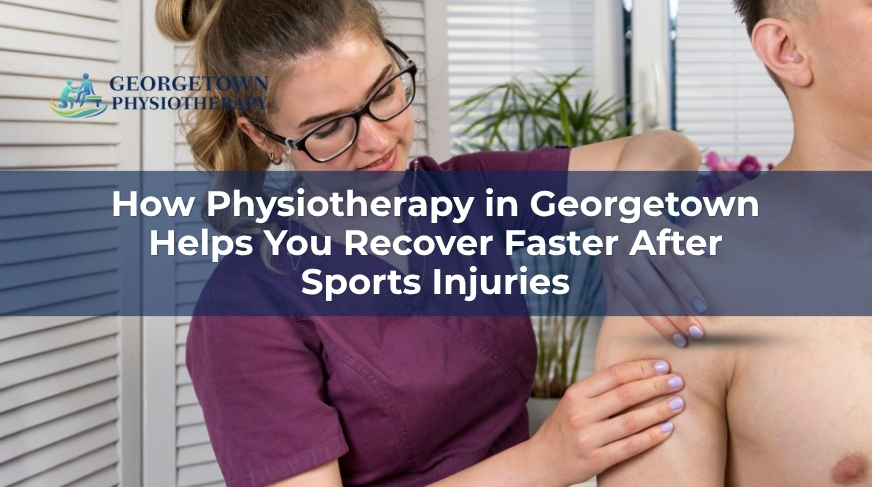
How Physiotherapy in Georgetown Helps You Recover Faster After Sports Injuries
A sports injury can happen in an instant.
A sudden change of direction can result in a knee injury. A poorly timed landing can affect the ankle. Repetitive overhead movements can irritate the shoulder. Even a gradual increase in running or training can lead to pain when the body’s current capacity isn’t ready for the additional workload.
For athletes and active adults, the biggest concern is often simple:
“How quickly can I get back to the activity I love?”
Physiotherapy can play an important role in sports injury recovery by assessing the injury, managing symptoms, restoring mobility, rebuilding strength, improving functional capacity, and progressively preparing the body for the demands of the sport.
However, faster recovery doesn’t mean rushing rehabilitation. Returning to sport before the body is adequately prepared can increase the risk of aggravation or reinjury.
A better goal is efficient, progressive, and appropriately monitored recovery.
At Georgetown Physiotherapy & Rehabilitation Centre, sports injury rehabilitation is tailored to the individual, the injury, the athlete’s activity level, and the physical demands of their sport.
Quick Answer: How Can Physiotherapy Help a Sports Injury?
Physiotherapy can support sports injury recovery through assessment, symptom management, mobility exercises, progressive strengthening, balance and coordination training, sport-specific rehabilitation, and a structured return-to-sport programme.
The exact treatment depends on the injury and individual assessment.
A recreational runner recovering from knee pain will need a different programme from a hockey player recovering from an ankle injury or a tennis player dealing with shoulder pain.
What Is a Sports Injury?
A sports injury is damage or irritation involving muscles, tendons, ligaments, joints, bones, or other tissues associated with physical activity.
Sports injuries can be:
Acute Injuries
These happen suddenly.
Examples include:
- Ankle sprains
- Muscle strains
- Ligament injuries
- Dislocations
- Fractures
- Acute shoulder injuries
Overuse Injuries
These develop gradually when repeated physical demands exceed the body’s ability to recover and adapt.
Examples can include:
- Tendinopathy
- Runner’s knee
- Shin pain
- Repetitive shoulder problems
- Overuse-related muscle pain
Understanding whether an injury is acute or related to repetitive loading helps determine an appropriate rehabilitation strategy.
Why Early Assessment Matters After a Sports Injury
Not every sports injury requires the same treatment.
A proper assessment can help identify:
- What movements are painful
- Whether mobility is restricted
- Whether strength has decreased
- Whether balance has been affected
- How the injury affects sport-specific activities
- What activities should temporarily be modified
- Whether further medical investigation is appropriate
This is important because pain alone doesn’t tell the whole story.
Two athletes may both report knee pain but have completely different movement limitations and rehabilitation needs.
How Physiotherapy Supports Sports Injury Recovery
1. Assessment and Diagnosis
Your physiotherapist begins by understanding what happened and how the injury is affecting you.
The assessment may include:
- Injury history
- Pain behaviour
- Range of motion
- Muscle strength
- Joint mobility
- Balance
- Functional movement
- Walking or running mechanics
- Sport-specific movements
Depending on the presentation, your physiotherapist may also identify signs that require referral for medical evaluation or imaging.
2. Managing Pain Without Completely Stopping Activity
Pain can make athletes afraid to move.
However, completely stopping all activity isn’t necessarily the best long-term strategy.
Your physiotherapist can help determine:
- Which activities are appropriate
- Which movements should temporarily be modified
- How much loading is reasonable
- When activity can be increased
This can allow you to maintain as much physical conditioning as appropriate while the injured area recovers.
3. Restoring Mobility
Injuries can cause stiffness and reduced range of motion.
For example:
- An ankle injury may reduce ankle mobility.
- A shoulder injury may limit overhead movement.
- A knee injury may make bending difficult.
- A back injury may affect comfortable rotation.
Physiotherapy may use:
- Mobility exercises
- Stretching
- Active range-of-motion exercises
- Manual therapy where appropriate
- Movement retraining
The objective is to restore the mobility required for your sport—not necessarily to achieve maximum flexibility.
4. Rebuilding Strength
Strength is one of the foundations of sports rehabilitation.
After an injury, muscles may become weaker because activity has been reduced.
Progressive strengthening may target:
- Core muscles
- Glutes
- Quadriceps
- Hamstrings
- Calves
- Shoulder muscles
- Rotator cuff
- Upper back
Strength exercises should become progressively more challenging as your capacity improves.
5. Improving Balance and Coordination
Balance and coordination are especially important for athletes involved in running, jumping, cutting, landing, and rapid changes of direction.
Rehabilitation may progress from simple exercises to more demanding tasks.
For example:
Single-leg balance → controlled squats → hopping → landing → directional changes → sport-specific movement
This progression helps bridge the gap between basic rehabilitation and real sporting demands.
6. Sport-Specific Rehabilitation
A major difference between general rehabilitation and sports rehabilitation is the final stage.
Your body needs to be prepared for the specific demands of your sport.
A Runner May Need:
- Running progression
- Single-leg strength
- Calf conditioning
- Endurance
- Impact tolerance
A Soccer Player May Need:
- Sprinting
- Cutting
- Kicking
- Balance
- Repeated acceleration and deceleration
A Tennis Player May Need:
- Shoulder strength
- Rotation
- Footwork
- Lateral movement
- Overhead activity
A Hockey Player May Need:
- Skating-related strength
- Balance
- Acceleration
- Direction changes
- Contact preparation
The closer rehabilitation becomes to your actual sport, the better it can prepare you for the demands you’ll face after returning.
7. Gradual Return to Sport
One of the biggest mistakes athletes make is returning as soon as the pain improves.
Pain reduction is encouraging, but it doesn’t automatically mean the body has regained:
- Strength
- Endurance
- Balance
- Coordination
- Power
- Sport-specific tolerance
A structured return may progress through stages such as:
Daily activities → basic exercise → sport-specific drills → controlled training → full training → competition
Your physiotherapist can help determine when and how to progress.
Why Rushing Back Can Be a Problem
Imagine an athlete who has stopped training for several weeks because of an injury.
The pain improves.
They immediately return to their previous training intensity.
The problem?
Their body may no longer have the same physical capacity.
The athlete may have lost:
- Strength
- Conditioning
- Coordination
- Confidence
- Load tolerance
The sudden increase in demand can aggravate symptoms.
Recovery should therefore be measured by function and capacity—not pain alone.
Physiotherapy for Common Sports Injuries
Ankle Sprains
Rehabilitation may focus on:
- Swelling management
- Range of motion
- Strength
- Balance
- Proprioception
- Running progression
Knee Injuries
Treatment may involve:
- Strengthening
- Mobility
- Balance
- Functional movement
- Jumping and landing
- Sport-specific drills
Shoulder Injuries
Rehabilitation may focus on:
- Shoulder mobility
- Rotator cuff strength
- Scapular control
- Upper-body conditioning
- Overhead movement
Muscle Strains
Treatment may include:
- Gradual loading
- Strengthening
- Flexibility
- Functional exercises
- Sport-specific progression
Tendon Problems
Tendon rehabilitation often requires carefully managed progressive loading rather than complete rest.
The Role of Exercise in Sports Rehabilitation
Exercise is one of the most important tools used in physiotherapy.
A personalized programme can help improve:
- Strength
- Endurance
- Mobility
- Balance
- Coordination
- Power
- Confidence
Exercise selection should reflect the individual’s current ability.
The objective isn’t simply to perform exercises.
It’s to progress toward the physical demands of the sport.
Can Massage Therapy Help Sports Recovery?
Massage therapy may help some athletes manage muscle tension and perceived soreness as part of a broader recovery strategy.
It should complement—not replace:
- Strength training
- Mobility work
- Appropriate conditioning
- Sleep
- Nutrition
- Rehabilitation
At Georgetown Physiotherapy & Rehabilitation Centre, massage therapy can be integrated with physiotherapy when clinically appropriate.
Can Chiropractic Care Be Part of Sports Rehabilitation?
Chiropractic care may be appropriate for certain musculoskeletal conditions and can sometimes be integrated into multidisciplinary rehabilitation.
Depending on the athlete’s needs, treatment may include:
- Manual therapy
- Joint mobilization
- Exercise
- Movement education
- Functional rehabilitation
The treatment should be based on assessment rather than assuming that every sports injury requires the same approach.
How Athletes Can Support Recovery at Home
Follow Your Rehabilitation Programme
Your prescribed exercises should be treated as part of your recovery plan.
Sleep Well
Adequate sleep is an important part of physical recovery.
Increase Training Gradually
Avoid sudden increases in training volume or intensity.
Maintain Appropriate Conditioning
Where possible, maintain fitness through activities that don’t aggravate the injury.
Listen to Changes in Symptoms
Significant or worsening symptoms should be discussed with your healthcare provider.
Common Sports Rehabilitation Mistakes
Returning to Competition Too Soon
Feeling better isn’t the same as being fully prepared.
Ignoring Strength Deficits
An injured body part may remain weaker even after pain improves.
Doing Only Passive Treatment
Hands-on treatment can be useful, but active rehabilitation is important for rebuilding physical capacity.
Skipping the Final Stage of Rehabilitation
Returning from basic exercises directly to full competition can create a significant jump in physical demand.
Increasing Training Too Quickly
Sudden increases in workload can exceed current capacity.
Comparing Your Recovery to Another Athlete
Two athletes with the same injury may have completely different recovery timelines.
When Should You See a Physiotherapist?
Consider a sports physiotherapy assessment if you:
- Have persistent sports-related pain
- Suffered an acute injury
- Have recurring injuries
- Lost strength after an injury
- Have reduced mobility
- Are struggling to return to training
- Feel unstable during sport
- Are unsure when to return to competition
- Want to improve physical capacity after recovery
A physiotherapist can assess your current function and help develop an appropriate progression.
When Should a Sports Injury Be Medically Assessed?
Some injuries require more than routine physiotherapy.
Seek appropriate medical assessment following:
- Suspected fracture
- Major trauma
- Significant joint deformity
- Inability to bear weight after an injury
- Severe or rapidly worsening swelling
- Major loss of strength
- Significant neurological symptoms
- Severe pain that isn’t improving
Emergency symptoms should receive urgent medical attention rather than waiting for a routine rehabilitation appointment.
Frequently Asked Questions
How quickly can physiotherapy help a sports injury?
Recovery varies according to the injury, severity, tissue involved, overall health, activity demands, and response to rehabilitation. No responsible clinician can guarantee a specific recovery time.
Can physiotherapy speed up sports injury recovery?
Appropriate physiotherapy can help structure rehabilitation, restore physical capacity, and guide progression. The goal isn’t to force the body to heal faster but to support an efficient and safe recovery process.
Should I stop exercising after a sports injury?
Not necessarily. Depending on the injury, you may be able to continue modified activities while protecting the injured area. Your physiotherapist can help determine what is appropriate.
When can I return to sport?
Return-to-sport timing depends on the injury and whether you have regained sufficient mobility, strength, control, conditioning, and sport-specific capacity.
Can physiotherapy prevent future sports injuries?
Physiotherapy may help address modifiable factors such as weakness, reduced mobility, poor conditioning, and inadequate load tolerance. However, no treatment can guarantee that an athlete will never be injured again.
Is massage enough to recover from a sports injury?
Usually, massage should not be considered a complete sports rehabilitation programme. Depending on the injury, active strengthening, mobility work, conditioning, and sport-specific progression may be necessary.
Do I need a physiotherapy assessment even if my pain is improving?
It can be useful when you have ongoing weakness, reduced mobility, recurring symptoms, or uncertainty about returning to sport. Pain improvement alone doesn’t always indicate complete recovery.
Why Choose Georgetown Physiotherapy & Rehabilitation Centre?
At Georgetown Physiotherapy & Rehabilitation Centre, sports injury rehabilitation is built around the athlete rather than a generic exercise programme.
Your treatment may include:
- Sports Injury Physiotherapy
- Therapeutic Exercise
- Strength Training
- Mobility Training
- Functional Rehabilitation
- Balance Training
- Manual Therapy
- Massage Therapy
- Chiropractic Care
- Laser Therapy
- Shockwave Therapy
- Sport-Specific Rehabilitation
- Return-to-Sport Planning
- Injury Prevention Education
The objective is to help you progress from injury → recovery → rebuilding capacity → sport-specific preparation → confident return to activity.
Georgetown Physiotherapy & Rehabilitation Centre
Address: 333 Mountainview Rd S, Unit #2, Georgetown, ON L7G 5S5, Canada
Phone: +1 905-702-6633
Email: info@georgetownphysiotherapy.ca
Website: https://georgetownphysiotherapy.ca/
Get Back to the Sport You Love
A sports injury can temporarily take you away from training and competition, but recovery shouldn’t be based on guesswork.
A structured physiotherapy programme can help you understand your injury, manage symptoms, rebuild strength and mobility, improve physical capacity, and progressively prepare for the demands of your sport.
If you’re searching for sports injury physiotherapy in Georgetown, contact Georgetown Physiotherapy & Rehabilitation Centre for an individualized assessment.
Recover properly. Rebuild your strength. Return to your sport with confidence.